

Capabilities

Prosperity Unabated,
Refinement Sustains the Premium:
26H1 Review & Prospect

Copy Url
Print
Download
Copy Url
Print
Download

Examining widening performance divergence as luxury enters a new phase of value validation, with pricing power increasingly anchored in earnings quality and operational resilience.

[2026H1 in a Nutshell]

Primary Index: In H1 2026, scarcity-led repricing gave way to more rigorous earnings validation. Currency headwinds, higher rates, and reduced earnings visibility compressed valuation support, producing an index path of modest early gains, a sharp March correction, a constrained recovery, and renewed weakness in June.

Secondary Index: Relative performance was increasingly determined by customer resilience and cash-flow visibility. Weakness in fashion and leather goods, compounded by currency pressure, drove the Core Luxe Index lower. Long order books and disciplined supply supported Ultra Luxe, while spirits destocking and softer middle-income discretionary demand weighed on Mass Luxe. Experiential Luxe finished broadly flat, underpinned by bookings, visitor traffic, and transaction-based revenues.
 
Constituent Stocks: Capital rotated decisively from brand prominence toward demonstrable operating delivery. Watches, travel retail, and premium department stores led as earnings recovered and operating leverage improved. Mid-ranking names preserved valuation support through full-price sell-through, channel discipline, and cash returns, while weaker demand, inventory normalization, and elevated investment requirements drove continued de-rating among laggards.
 
Macroeconomic Trends: Global equity gains sustained the wealth effect and supported high-net-worth consumption. This support was offset by Middle East conflict, higher oil prices, and rising European rates, which increased discount-rate pressure. Adverse currency translation further amplified losses in European assets, while weaker Chinese demand and softer brand-controlled retail deepened divergence across regions, customer segments, and categories.


[2026H2 Outlook]

Primary Index:  H2 2026 is expected to usher in a more demanding phase of earnings validation, as fundamental recovery becomes increasingly visible. The valuation narrative should shift from sentiment-led re-rating toward demonstrable profit improvement, stronger cash conversion, and more credible delivery against expectations.
 
Secondary Index: Structural divergence is likely to persist. Ultra Luxe should remain comparatively resilient, supported by order-book visibility and disciplined supply. Core Luxe will depend on stabilization across fashion and leather goods, with jewelry and watches providing a degree of downside support. Mass Luxe remains tied to the pace of spirits destocking and the recovery of middle-income discretionary demand, while Experiential Luxe should sustain momentum but face greater scrutiny over expansion efficiency and earnings conversion.
 
Constituent Stocks: Capital allocation is likely to become increasingly concentrated around a narrower group of proven operators. High-resilience names should continue to command valuation premiums through full-price sell-through, robust cash generation, and consistent shareholder returns. Experience-led value creators may unlock further growth through occasion innovation and deeper emotional engagement, but sustained re-rating will depend on their ability to convert traffic into repeat purchasing, stronger unit economics, and durable customer value.
 
Macroeconomic Trends: Wealth effects, the path of interest rates, and currency movements will remain the principal macro drivers of high-end consumption. An easing in energy and geopolitical pressures, together with continued recovery in cross-border traffic, could provide incremental support. However, an uneven global recovery and persistently subdued domestic demand in China are likely to limit the breadth and pace of any sector-wide rebound.
 
Looking back on the first half of 2026, the luxury sector moved decisively from valuation recovery predicated on improving demand toward a more exacting phase of earnings validation under multiple headwinds. The index correction was not driven by any single shock; rather, it reflected a broad-based repricing shaped by geopolitical tensions, higher energy prices, rising European interest rates, adverse currency translation, and widening dispersion in brand-level execution.


High-net-worth consumption continued to benefit from global asset appreciation, while aspirational demand among middle-income consumers and broader discretionary spending became increasingly restrained. Currency headwinds, inventory pressure, and intensifying promotional activity further widened the gap between stronger and weaker operators. As a result, the market shifted from assigning premiums to brand narratives toward rewarding demonstrable full-price sell-through, margin resilience, and cash-flow delivery.

Within this environment, more rigorous valuation scrutiny at the primary-index level, K-shaped divergence across the secondary indices, and the increasing convergence of stock-level pricing around operating evidence defined the sector’s central evolution during the first half of 2026.

More specifically, after a brief recovery at the beginning of the year, the market applied a materially higher threshold to earnings certainty across the luxury sector. Although the primary index initially advanced before reversing and ultimately closing lower, this did not signal a broad deterioration in fundamentals. Rather, the limited improvement in operating performance proved insufficient to sustain a higher valuation range. Investors became less willing to price in recovery expectations indiscriminately, shifting their focus toward current earnings quality, cash conversion, and the credibility and timing of delivery.

At the secondary-index level, relative performance was shaped by the interaction of customer resilience and business-model visibility. Within Core Luxe, the jewelry and watches sector outperformed the fashion and leather goods sector: jewelry benefited from its value-retention attributes and gifting demand, while the fashion and leather goods sector remained constrained by weaker traffic, inventory pressure, and creative transitions. Ultra Luxe, by contrast, demonstrated stronger defensive characteristics through long-duration order books, customization revenue, and structurally constrained supply.

Mass Luxe remained the most exposed to middle-income purchasing power and channel inventories. Beauty and fragrance sustained growth through repeat purchasing and product innovation, but this resilience was insufficient to offset spirits destocking and softer demand across home-related categories. Experiential Luxe, meanwhile, was supported by cruises, hospitality, gaming, and art transactions, once again highlighting the structural resilience of experience-led expenditure.

As divergence intensified, capital allocation became increasingly concentrated among a narrower group of assets offering verifiable resilience. Leading Performers outperformed through earnings recovery and the release of operating leverage. Mid-tier Stocks names preserved valuation support through disciplined full-price distribution, dependable cash generation, and shareholder returns. Tail-end Stocks, weaker demand, inventory normalization, and elevated investment requirements combined to create a negative feedback loop of slowing revenue, mounting margin pressure, and continued valuation compression.


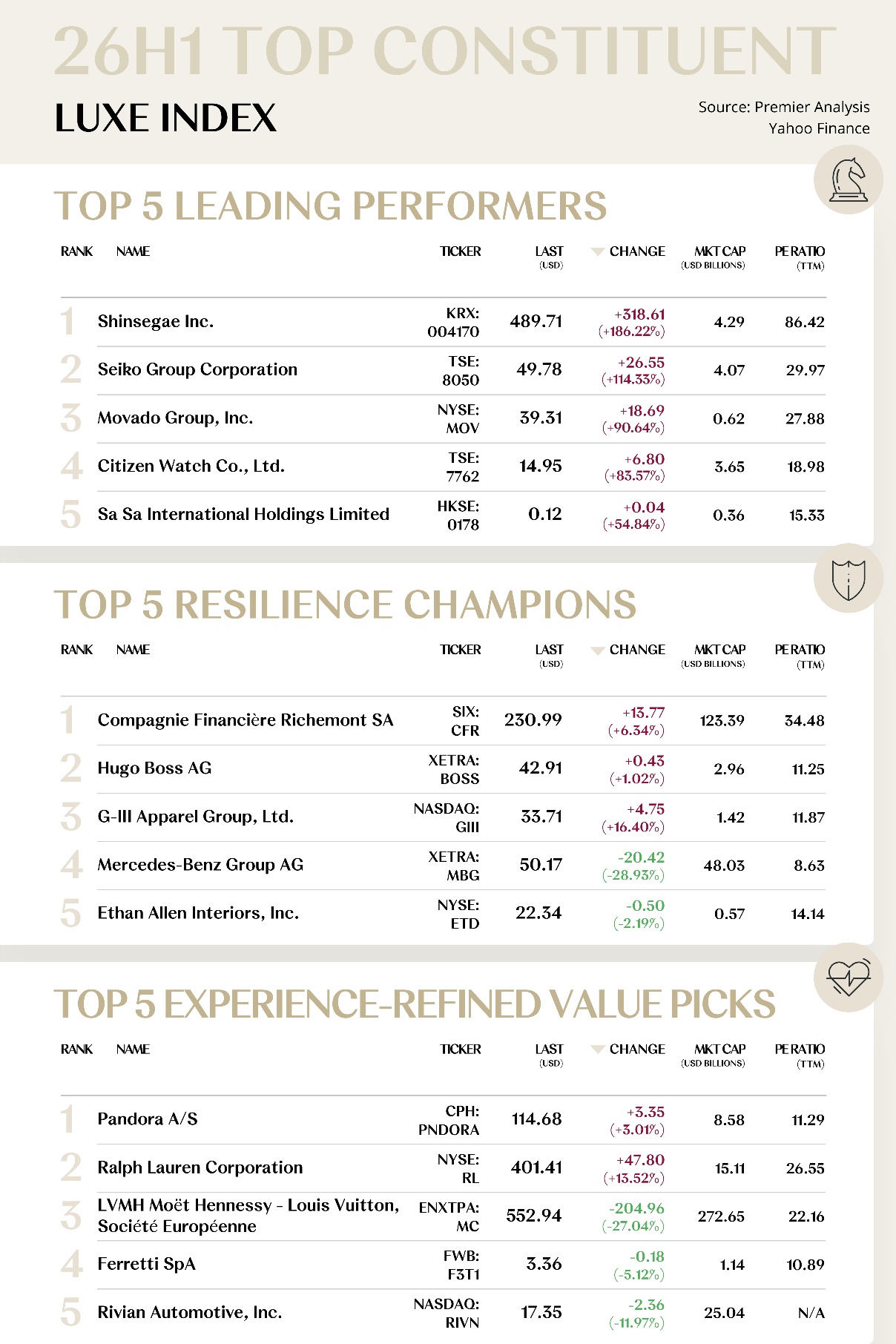
Within this framework, Leading Performers such as Shinsegae, Seiko, Movado, Citizen Watch, and Sa Sa International emerged as clear market standouts and became focal points for capital allocation.

From a macro perspective, continued gains across global equity markets sustained the wealth effect and provided tangible support to high-net-worth consumption, while the recovery in cross-border mobility reinforced travel retail and experience-led spending. These tailwinds were offset by the combined effects of conflict in the Middle East, higher oil prices, rising European interest rates, and adverse currency translation. At the same time, subdued domestic demand in China further widened performance dispersion across regions and customer segments.

Taken together, the macro environment did not generate a uniform sector-wide uplift. Instead, the interaction of wealth effects, interest rates, currency movements, and geopolitical risk reshaped the industry’s relative performance hierarchy, leaving the luxury sector in a regime defined by underlying resilience but increasingly pronounced divergence.

Looking ahead to the second half of 2026, the dominant index narrative is expected to shift from valuation validation toward earnings delivery. With macro headwinds yet to recede fully and operating performance continuing to diverge, capital markets are likely to become less tolerant of traffic-recovery narratives and brand storytelling unsupported by financial evidence. Valuation anchors should therefore become more firmly tied to full-price sell-through, margin resilience, free-cash-flow generation, and execution credibility.

Accordingly, further index upside is more likely to arise from the stabilization and selective expansion of valuation ranges supported by demonstrable operating progress, rather than from a broad-based return to historical multiples. Companies capable of converting traffic consistently into earnings and cash flow are therefore better positioned to become the principal contributors to index resilience.

Against a backdrop of persistent currency volatility and a higher threshold for earnings delivery, divergence across the secondary indices is likely to remain pronounced. Within Core Luxe, a recovery in fashion and leather goods—supported by continued resilience in jewelry and established iconic products—could create the conditions for renewed leadership. Ultra Luxe, by contrast, should retain its defensive role and strategic allocation appeal through long-duration order books, structurally scarce supply, and comparatively low price sensitivity.

For Mass Luxe, the key variables remain the cyclical progression of its core categories. Completion of channel destocking in spirits, combined with sustained new-product productivity in beauty and fragrance, could move the segment from stabilization toward gradual recovery. Experiential Luxe should remain comparatively more predictable, supported by resilient demand across premium travel, hospitality, and cruises. Its performance, however, will depend increasingly on the balance among capacity expansion, booking visibility, unit revenue, capital intensity, and cost discipline.

Investor attention is expected to remain highly concentrated, with capital allocation tilting further toward assets offering verifiable certainty. High-resilience names such as Richemont, Mercedes-Benz, Embraer, L’Oréal, and Hilton should remain well positioned to command valuation premiums through strong brand and order-book barriers, disciplined full-price distribution, robust balance sheets, and dependable cash returns.

For Experience-Refined Value Picks including Pandora, Ralph Lauren, LVMH, Royal Caribbean, and Hyatt, the valuation case will depend on whether product innovation, occasion-based engagement, and customer connectivity can be translated into repeatable growth engines. Critical evidence will include the contribution of new products to average transaction value and repeat purchasing, improvements in channel and booking efficiency, and the conversion of organizational execution, resource allocation, and expansion investment into earnings and free cash flow. Collectively, these factors will determine whether individual names can progress from cyclical recovery toward structural growth.

By comparison, less differentiated brands and companies with weaker channel control are likely to remain exposed to elevated operating friction. Limited demand resilience, combined with inventory pressure, discounting, and high fixed costs, may continue to constrain revenue quality and limit the pace of margin recovery.

At the macro level, oil prices, European interest rates, currency movements, renminbi-denominated wealth effects, and Chinese outbound travel will remain the principal variables shaping the sector’s underlying demand foundation. An easing of geopolitical and energy pressures, together with stable major asset prices, could provide incremental support to high-end consumption and sector valuations. Uneven global growth, subdued domestic demand in China, and recurring trade-policy uncertainty will nevertheless continue to elevate the sector’s volatility profile.

As cross-border consumption and global distribution networks continue to recover, macro sensitivity will become increasingly concentrated in currency pass-through and shifts in regional supply-demand conditions. Brands will therefore need to manage global price architecture, regional product allocation, and inventory cadence dynamically, while simultaneously optimizing supply chains, production planning, and capital deployment. These capabilities will be essential to absorbing external shocks, protecting gross-margin structures, and sustaining long-term brand momentum.

DOWNLOADS

Lite Report (107 pages)

Term Name

Technology Introduction

Energy is life. It powers industries, empowers communities, and builds societies. The world needs energy—affordable, reliable, and sustainable energy. But meeting the world’s energy requirements with net-zero climate impact is one of today’s most complex challenges.

Energy companies need to leverage the latest technologies, re-engineer processes, and rethink business models to drive change. Premier works with clients to build sustainable, competitive energy solutions to achieve a net-zero energy world for all.

Business Application

  • Customization of Medical Devices, Prosthetics and Prostheses: Customized manufacturing can be carried out, designed and manufactured according to the individual needs of patients, and more suitable solutions can be provided
  • Manufacture Lightweight Components: For rapid prototyping, customized production and small batch production, it can reduce production cycle and cost

Related Giant

Related Technology Trend

Related Technology

Examining widening performance divergence as luxury enters a new phase of value validation, with pricing power increasingly anchored in earnings quality and operational resilience.

[2026H1 in a Nutshell]

Primary Index: In H1 2026, scarcity-led repricing gave way to more rigorous earnings validation. Currency headwinds, higher rates, and reduced earnings visibility compressed valuation support, producing an index path of modest early gains, a sharp March correction, a constrained recovery, and renewed weakness in June.

Secondary Index: Relative performance was increasingly determined by customer resilience and cash-flow visibility. Weakness in fashion and leather goods, compounded by currency pressure, drove the Core Luxe Index lower. Long order books and disciplined supply supported Ultra Luxe, while spirits destocking and softer middle-income discretionary demand weighed on Mass Luxe. Experiential Luxe finished broadly flat, underpinned by bookings, visitor traffic, and transaction-based revenues.
 
Constituent Stocks: Capital rotated decisively from brand prominence toward demonstrable operating delivery. Watches, travel retail, and premium department stores led as earnings recovered and operating leverage improved. Mid-ranking names preserved valuation support through full-price sell-through, channel discipline, and cash returns, while weaker demand, inventory normalization, and elevated investment requirements drove continued de-rating among laggards.
 
Macroeconomic Trends: Global equity gains sustained the wealth effect and supported high-net-worth consumption. This support was offset by Middle East conflict, higher oil prices, and rising European rates, which increased discount-rate pressure. Adverse currency translation further amplified losses in European assets, while weaker Chinese demand and softer brand-controlled retail deepened divergence across regions, customer segments, and categories.


[2026H2 Outlook]

Primary Index:  H2 2026 is expected to usher in a more demanding phase of earnings validation, as fundamental recovery becomes increasingly visible. The valuation narrative should shift from sentiment-led re-rating toward demonstrable profit improvement, stronger cash conversion, and more credible delivery against expectations.
 
Secondary Index: Structural divergence is likely to persist. Ultra Luxe should remain comparatively resilient, supported by order-book visibility and disciplined supply. Core Luxe will depend on stabilization across fashion and leather goods, with jewelry and watches providing a degree of downside support. Mass Luxe remains tied to the pace of spirits destocking and the recovery of middle-income discretionary demand, while Experiential Luxe should sustain momentum but face greater scrutiny over expansion efficiency and earnings conversion.
 
Constituent Stocks: Capital allocation is likely to become increasingly concentrated around a narrower group of proven operators. High-resilience names should continue to command valuation premiums through full-price sell-through, robust cash generation, and consistent shareholder returns. Experience-led value creators may unlock further growth through occasion innovation and deeper emotional engagement, but sustained re-rating will depend on their ability to convert traffic into repeat purchasing, stronger unit economics, and durable customer value.
 
Macroeconomic Trends: Wealth effects, the path of interest rates, and currency movements will remain the principal macro drivers of high-end consumption. An easing in energy and geopolitical pressures, together with continued recovery in cross-border traffic, could provide incremental support. However, an uneven global recovery and persistently subdued domestic demand in China are likely to limit the breadth and pace of any sector-wide rebound.
 
Looking back on the first half of 2026, the luxury sector moved decisively from valuation recovery predicated on improving demand toward a more exacting phase of earnings validation under multiple headwinds. The index correction was not driven by any single shock; rather, it reflected a broad-based repricing shaped by geopolitical tensions, higher energy prices, rising European interest rates, adverse currency translation, and widening dispersion in brand-level execution.


High-net-worth consumption continued to benefit from global asset appreciation, while aspirational demand among middle-income consumers and broader discretionary spending became increasingly restrained. Currency headwinds, inventory pressure, and intensifying promotional activity further widened the gap between stronger and weaker operators. As a result, the market shifted from assigning premiums to brand narratives toward rewarding demonstrable full-price sell-through, margin resilience, and cash-flow delivery.

Within this environment, more rigorous valuation scrutiny at the primary-index level, K-shaped divergence across the secondary indices, and the increasing convergence of stock-level pricing around operating evidence defined the sector’s central evolution during the first half of 2026.

More specifically, after a brief recovery at the beginning of the year, the market applied a materially higher threshold to earnings certainty across the luxury sector. Although the primary index initially advanced before reversing and ultimately closing lower, this did not signal a broad deterioration in fundamentals. Rather, the limited improvement in operating performance proved insufficient to sustain a higher valuation range. Investors became less willing to price in recovery expectations indiscriminately, shifting their focus toward current earnings quality, cash conversion, and the credibility and timing of delivery.

At the secondary-index level, relative performance was shaped by the interaction of customer resilience and business-model visibility. Within Core Luxe, the jewelry and watches sector outperformed the fashion and leather goods sector: jewelry benefited from its value-retention attributes and gifting demand, while the fashion and leather goods sector remained constrained by weaker traffic, inventory pressure, and creative transitions. Ultra Luxe, by contrast, demonstrated stronger defensive characteristics through long-duration order books, customization revenue, and structurally constrained supply.

Mass Luxe remained the most exposed to middle-income purchasing power and channel inventories. Beauty and fragrance sustained growth through repeat purchasing and product innovation, but this resilience was insufficient to offset spirits destocking and softer demand across home-related categories. Experiential Luxe, meanwhile, was supported by cruises, hospitality, gaming, and art transactions, once again highlighting the structural resilience of experience-led expenditure.

As divergence intensified, capital allocation became increasingly concentrated among a narrower group of assets offering verifiable resilience. Leading Performers outperformed through earnings recovery and the release of operating leverage. Mid-tier Stocks names preserved valuation support through disciplined full-price distribution, dependable cash generation, and shareholder returns. Tail-end Stocks, weaker demand, inventory normalization, and elevated investment requirements combined to create a negative feedback loop of slowing revenue, mounting margin pressure, and continued valuation compression.


Within this framework, Leading Performers such as Shinsegae, Seiko, Movado, Citizen Watch, and Sa Sa International emerged as clear market standouts and became focal points for capital allocation.

From a macro perspective, continued gains across global equity markets sustained the wealth effect and provided tangible support to high-net-worth consumption, while the recovery in cross-border mobility reinforced travel retail and experience-led spending. These tailwinds were offset by the combined effects of conflict in the Middle East, higher oil prices, rising European interest rates, and adverse currency translation. At the same time, subdued domestic demand in China further widened performance dispersion across regions and customer segments.

Taken together, the macro environment did not generate a uniform sector-wide uplift. Instead, the interaction of wealth effects, interest rates, currency movements, and geopolitical risk reshaped the industry’s relative performance hierarchy, leaving the luxury sector in a regime defined by underlying resilience but increasingly pronounced divergence.

Looking ahead to the second half of 2026, the dominant index narrative is expected to shift from valuation validation toward earnings delivery. With macro headwinds yet to recede fully and operating performance continuing to diverge, capital markets are likely to become less tolerant of traffic-recovery narratives and brand storytelling unsupported by financial evidence. Valuation anchors should therefore become more firmly tied to full-price sell-through, margin resilience, free-cash-flow generation, and execution credibility.

Accordingly, further index upside is more likely to arise from the stabilization and selective expansion of valuation ranges supported by demonstrable operating progress, rather than from a broad-based return to historical multiples. Companies capable of converting traffic consistently into earnings and cash flow are therefore better positioned to become the principal contributors to index resilience.

Against a backdrop of persistent currency volatility and a higher threshold for earnings delivery, divergence across the secondary indices is likely to remain pronounced. Within Core Luxe, a recovery in fashion and leather goods—supported by continued resilience in jewelry and established iconic products—could create the conditions for renewed leadership. Ultra Luxe, by contrast, should retain its defensive role and strategic allocation appeal through long-duration order books, structurally scarce supply, and comparatively low price sensitivity.

For Mass Luxe, the key variables remain the cyclical progression of its core categories. Completion of channel destocking in spirits, combined with sustained new-product productivity in beauty and fragrance, could move the segment from stabilization toward gradual recovery. Experiential Luxe should remain comparatively more predictable, supported by resilient demand across premium travel, hospitality, and cruises. Its performance, however, will depend increasingly on the balance among capacity expansion, booking visibility, unit revenue, capital intensity, and cost discipline.

Investor attention is expected to remain highly concentrated, with capital allocation tilting further toward assets offering verifiable certainty. High-resilience names such as Richemont, Mercedes-Benz, Embraer, L’Oréal, and Hilton should remain well positioned to command valuation premiums through strong brand and order-book barriers, disciplined full-price distribution, robust balance sheets, and dependable cash returns.

For Experience-Refined Value Picks including Pandora, Ralph Lauren, LVMH, Royal Caribbean, and Hyatt, the valuation case will depend on whether product innovation, occasion-based engagement, and customer connectivity can be translated into repeatable growth engines. Critical evidence will include the contribution of new products to average transaction value and repeat purchasing, improvements in channel and booking efficiency, and the conversion of organizational execution, resource allocation, and expansion investment into earnings and free cash flow. Collectively, these factors will determine whether individual names can progress from cyclical recovery toward structural growth.

By comparison, less differentiated brands and companies with weaker channel control are likely to remain exposed to elevated operating friction. Limited demand resilience, combined with inventory pressure, discounting, and high fixed costs, may continue to constrain revenue quality and limit the pace of margin recovery.

At the macro level, oil prices, European interest rates, currency movements, renminbi-denominated wealth effects, and Chinese outbound travel will remain the principal variables shaping the sector’s underlying demand foundation. An easing of geopolitical and energy pressures, together with stable major asset prices, could provide incremental support to high-end consumption and sector valuations. Uneven global growth, subdued domestic demand in China, and recurring trade-policy uncertainty will nevertheless continue to elevate the sector’s volatility profile.

As cross-border consumption and global distribution networks continue to recover, macro sensitivity will become increasingly concentrated in currency pass-through and shifts in regional supply-demand conditions. Brands will therefore need to manage global price architecture, regional product allocation, and inventory cadence dynamically, while simultaneously optimizing supply chains, production planning, and capital deployment. These capabilities will be essential to absorbing external shocks, protecting gross-margin structures, and sustaining long-term brand momentum.