The Irreplaceability Imperative:
Defining Luxury’s Next Era of Growth
Luxury Industry Outlook 2026
The Irreplaceability Imperative:
Defining Luxury’s Next Era of Growth
Luxury Industry Outlook 2026


Eight key trends provide luxury brands with a strategic course at a moment when growth is diverging and sources of value are shifting at speed—moving the industry from scale expansion towards deeper value creation, and rebuilding irreplaceability through the Foundations of Brand Meaning, the Magnetic Pull of Brand Desirability and the Depth of Brand Affinity to unlock the next cycle of high-quality growth.
Irreplaceability is not a new rhetoric for luxury. It is the defining imperative of its next growth cycle.
In 2026, the global luxury market is expected to grow by 3.0%. Yet that growth will no longer accrue evenly across categories, consumer segments or brands. Experiential luxury is projected to expand by 4.1%, while the core personal luxury goods segment is expected to grow by only around 0.5%. Nearly half of affluent consumers still intend to increase their luxury spending; among aspirational consumers, fewer than one in three plan to do the same. Demand has not receded. It is becoming more discriminating about where it goes. Consumers still aspire to luxury, but are less willing to pay for symbolism alone—and more exacting in the questions they ask:
What makes a product worth its price? What makes an experience endure in memory? And what makes a brand worthy of a lasting place in one’s life?
More than 80% of the industry’s growth in the previous cycle came from price increases rather than volume expansion. Price once amplified value; today, it increasingly puts value to the test. When product innovation, artisanal excellence, service experience and cultural creation fail to advance in concert, higher prices cease to attest to scarcity. Instead, they expose the unresolved value gap between a brand and its clients. The predicament confronting luxury is therefore not merely how to restore purchase. It is how to become, once again, the choice that cannot readily be replaced.
It is against this backdrop that Premier sets out the Eight Luxury Trends for 2026. They begin with an examination of diverging growth trajectories and shifting sources of value, yet collectively point towards a more fundamental question: how can brands rebuild the foundations of meaning, renew the magnetic pull of desirability and deepen the bonds of affinity—fortifying preference among existing clients, engendering it among new ones and, step by step, becoming irreplaceable?
This requires brands to restore three essential foundations.
The first is the Foundation of Brand Meaning. Materials, craftsmanship, creativity and quality remain the inalienable origins of luxury value. Heritage becomes consequential only when it is reinterpreted through contemporary products. Craftsmanship acquires meaning only when it can be genuinely perceived by the client. Promises become credible only when they are repeatedly honored across purchase, use, care, repair and service. Only then can narrative accrue into reputation, and rarity mature into trust. Price is no longer a surrogate for value, but the consequence of value fully conceived and consistently delivered.
The second is the Magnetic Pull of Brand Desirability. Luxury is expanding from something one owns into a world in which one participates. The growing share of expenditure devoted to travel, gastronomy, art, wellbeing and private experiences does not imply that the product has lost its centrality. Rather, it reveals a deeper meaning of luxury: people are not merely purchasing an object. They are choosing how their time is spent, how their relationships are cherished and how the self is understood. What brands must contend for, therefore, is no longer merely share of wallet, but share of life—not only a place in the client’s wardrobe or collection, but a place in how they imagine and define a life well lived.
The third is the Depth of Brand Affinity. Irreplaceability must be deepened among existing clients and cultivated among new ones. For established clients, brands must transcend episodic transactions and short-lived loyalty. They must remain relevant as life stages, everyday contexts and personal values evolve, giving clients continual reason to reaffirm: “Why do I still choose this brand?” For a new generation of consumers, it is not enough to offer more accessible products or lower points of entry. Every first encounter must open into a deeper understanding of value, a stronger sense of identification and a progressive relationship with the brand—until consumers come to understand: “Why will nothing else do?”
Irreplaceability must therefore be embedded in the operating system of the business; it cannot remain confined to brand narrative or communication. It requires retail to move from expansive proliferation to the exacting stewardship of strategic assets; capital to shift from portfolio expansion towards control of the core ecosystem; and creativity to transcend the impact of a single season and become a brand-wide interpretive force. It also requires price architecture to return to the logic of value creation, client development to sustain long-term progression, and AI to evolve from back-office efficiency into relationship intelligence. The eight trends examined in this report are manifestations of the same profound transition: from expanding the perimeter to fortifying the core; from competing for visibility to creating irreplaceability.
The next cycle of growth will no longer reward, indiscriminately, the brands that speak louder, open more stores or raise prices more frequently. It will flow towards those capable of both safeguarding the value roots of luxury and entering the lived realities of their clients—giving established clients renewed reason to affirm, “Why do I still choose this brand?” while enabling new ones to understand, “Why will nothing else do?”
The ultimate expression of irreplaceability is not simply to remain seen, considered or purchased.
It is to move from one choice among many to the choice—
And, as time unfolds, the only one.
DOWNLOADS

Lite Report (101 pages)
01. MARKET OUTLOOK
Share of Life Redefines Luxury Growth
Luxury’s value equation moves beyond the product and into lived experience
In 2026, the global luxury market is no longer advancing through a single high-growth narrative. Growth remains, but it is slower, more selective and increasingly dependent on the quality of demand, the density of consumption occasions and the reorganization of experiential value.
The global luxury market is expected to reach approximately €2.037 trillion in 2026, growing 3.0% year on year, modestly faster than 2.7% in 2025. The industry is returning to a more disciplined and constrained growth trajectory. The central task for brands is shifting from recovering growth to reorganizing it: bringing products, experiences, client segments and service into a more coherent lifestyle proposition.
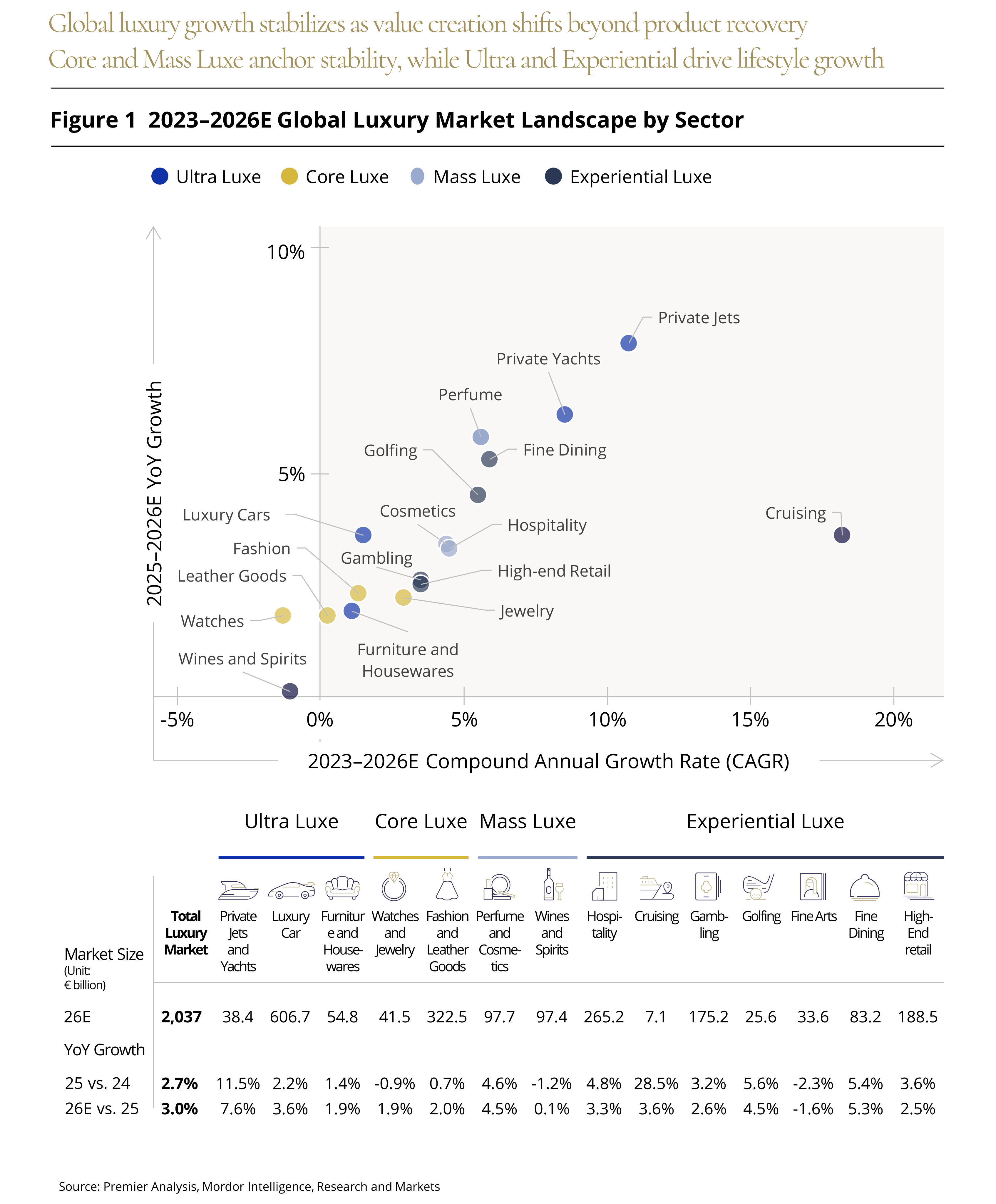
Experiential Luxe is set to become the strongest growth engine in 2026. The underlying shift is not that consumers are simply buying more, but that luxury experience is extending beyond the boutique into a much broader set of life contexts—from the sea and the air to hotels, dining and wellbeing. Experiential Luxe is projected to grow 4.1% year on year in 2026, the strongest performance across the luxury ecosystem. The competitive question ahead is no longer only who has the better product, but which brands can remain perceptible to clients for longer and across more meaningful contexts.
Ultra Luxe growth is shifting from product consumption towards an asset-based lifestyle. The segment is expected to expand by 2.6% in 2026, continuing to benefit from the structural expansion of global HNWI wealth. For brands, competition in Ultra Luxe is therefore moving beyond the ability to manufacture expensive products towards the ability to manage access to scarce lifestyles.
Core Luxe is expected to grow by only 0.5% year on year. The pace is modest, yet the segment continues to carry the core value architecture of luxury, even as category performance becomes more polarized. The question for Core Luxe is no longer whether prices can continue to rise, but how brands can rebuild the reasons to buy, restore conviction in price and remain the preferred choice.
Mass Luxe continues to play a critical role in serving younger and entry-level luxury consumers. The segment is expected to grow 1.6% in 2026—not the strongest source of expansion, but an important layer through which brands enter everyday consumption occasions. Its role should therefore be assessed beyond near-term revenue: Mass Luxe can act as the front end of relationship cultivation, using more accessible points of entry to build familiarity, aesthetic affinity and usage habits, while creating the conditions for clients to move into higher price tiers over time.
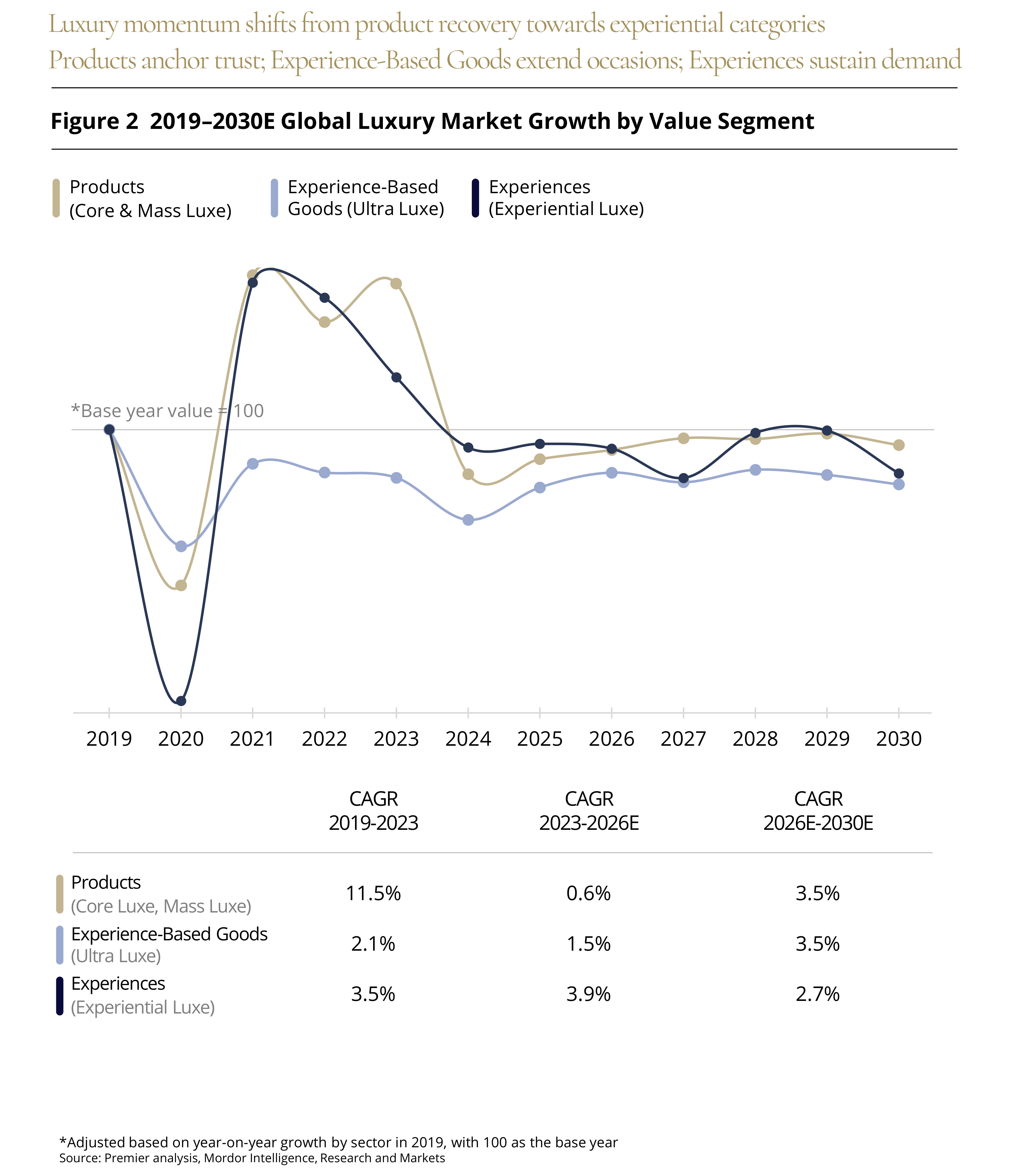
Looking back from the pre-pandemic baseline, the growth logic of luxury has undergone a structural reallocation.
From 2019 to 2023, Products formed the market’s strongest recovery anchor. Price elevation, the resilience of ownership-led demand and the faster restoration of product value together made Core Luxe and Mass Luxe the principal sources of growth during the recovery phase.
Between 2023 and 2026, the market entered a period of structural adjustment. Growth no longer remained concentrated in Products, but began migrating towards Experiences and Experience-Based Goods. By contrast, Products, after their sharp post-pandemic recovery, returned to a steadier growth trajectory.
Looking ahead to 2026–2030, luxury growth is expected to become more balanced, although the pace across value segments will diverge again. Products will reassert their role as a stabilizer for the industry’s core business; Experience-Based Goods will gain strategic weight as luxury consumption extends further into lifestyle and access-led models. Experiential Luxe will remain a highly important value pool, although its growth rate is expected to become more measured than in the preceding phase.
Future competition will move beyond individual product sales towards the integrated management of product, service, travel, retail and client relationships. Brands will need to recalibrate their value anchors: build trust through product, sustain relationships through experience, and extend the effective reach of brand equity through lifestyle.
02. BRAND STRATEGY
Authenticity Reasserts Brand Authority
Craft embodies integrity; Exceptional service makes the brand promise tangible
Luxury pricing power is entering a period of value validation, and further premium growth will require more substantial brand foundations.
As inflation moderates and consumer confidence remains subdued, average luxury prices continue to rise, making the disconnect between pricing and the underlying demand environment increasingly visible. Over recent years, industry growth has depended more on brand strength, scarcity and premiumization than on a natural recovery in demand. Price can still support revenue, but it is also making the market more exacting about high premiums. In the next phase, brands will need to substantiate price through craftsmanship, service, scarcity and experience—so that “more expensive” once again clearly corresponds to “more worthwhile”.
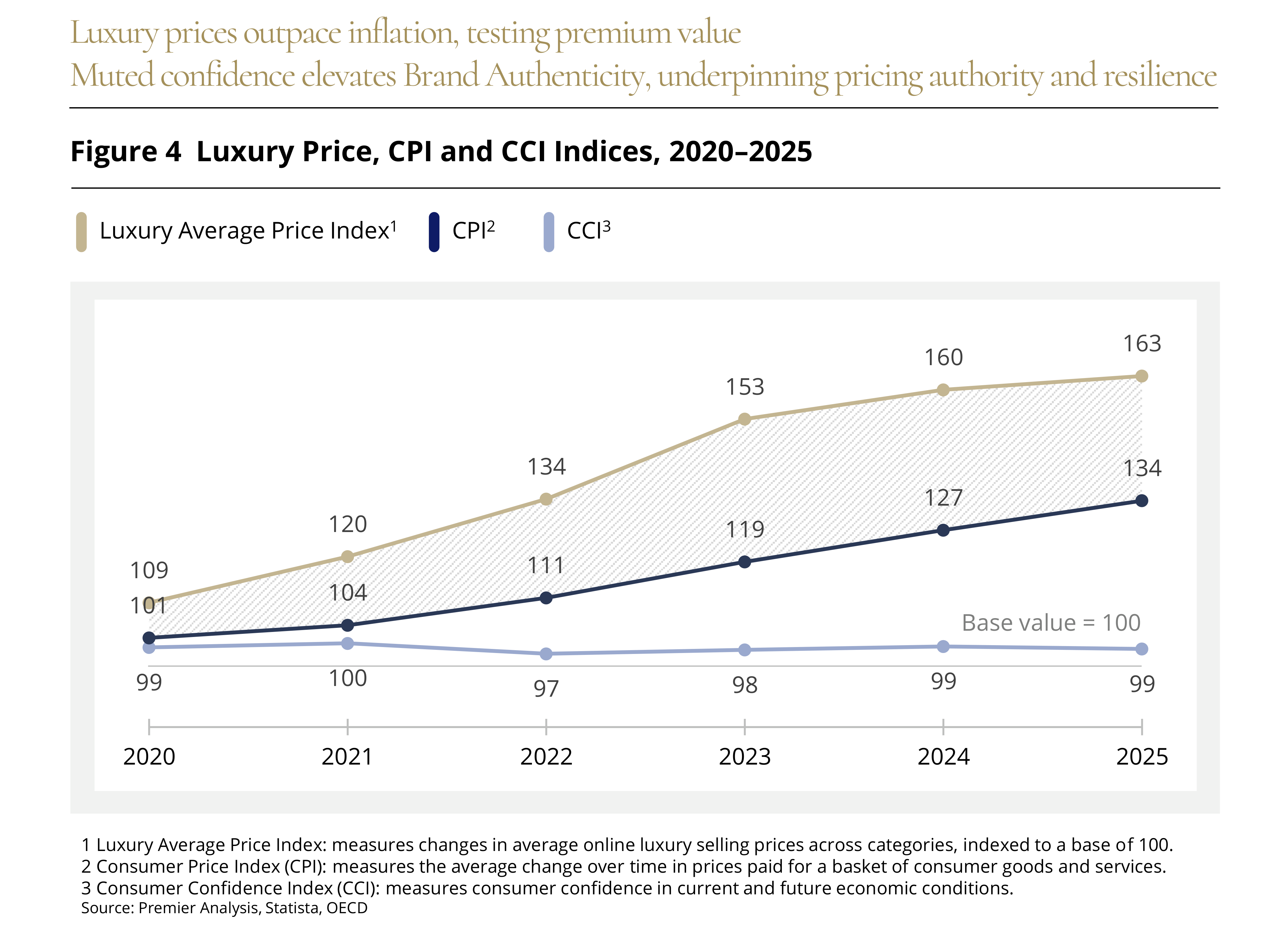
As premium pricing enters a period of closer validation, Brand Authenticity is becoming a critical basis for consumers to assess whether a premium is truly justified. Exceptional craftsmanship has become the entry ticket to luxury and the first layer through which consumers judge the substance of brand value. Market scrutiny is now extending further, with greater attention paid to whether brands can translate product quality, consistency of service, personalized responsiveness, and the completeness of the overall experience into credible, traceable foundations of value.
Consumers remain willing to pay for premium positioning, but they are becoming more deliberate in determining whether that premium is warranted. A single boutique interaction, an after-sales service experience, a personalized recommendation, or even the speed of response within a long-term client relationship can all shape perceptions of brand value. Looking ahead, the brands best positioned to win will be those able to combine clear value articulation, consistent delivery, and greater authenticity, ensuring that premium positioning extends beyond price and image to become value that is tangible, verifiable, and trusted over time.
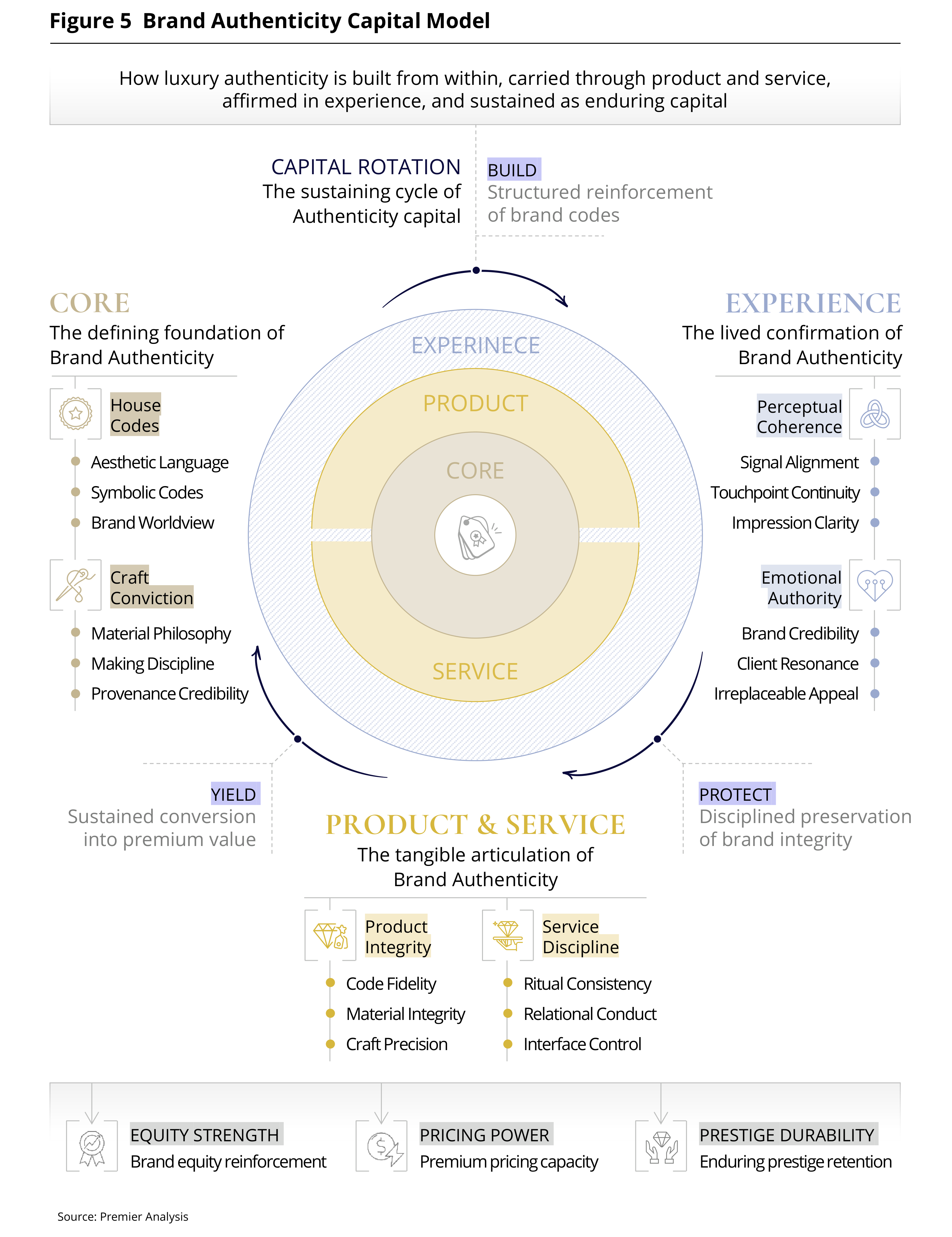
Premier defines Brand Authenticity as a form of capital that can accumulate over time and be continuously converted into commercial returns. It is rooted in the brand’s intrinsic foundations, carried through products and services, validated through lived experience, and ultimately crystallized into enduring capital capable of sustaining long-term value creation. Within this framework, authenticity moves beyond a single brand attribute to become a disciplined, continuously activated system of value creation.
For authenticity to become a sustainable source of value, brands need to reinforce their core codes, protect brand integrity across products, services and experiences, and convert accumulated consistency into premium returns. In Premier’s framework, this is the essential mechanism of Authenticity Capital Rotation: build a structured system of brand codes so that identity and value expression remain clear; protect brand integrity so that every product, service and experience conforms to house standards; and yield premium value by converting clients’ perception of and trust in authenticity into brand equity, pricing power and long-term returns.
As this system connects the Core, Product & Service and Experience layers, Brand Authenticity ceases to function merely as an image asset and becomes genuine value capital. It reinforces brand equity, strengthening authority both internally and in the market; expands pricing power by giving premium positioning a more credible foundation; and sustains prestige over time, preserving the brand’s symbolic meaning and market standing through changing cycles.
03. CHINA IN FOCUS
Luxury Retail Refocuses on Higher-Impact Doors
Global flagships anchor brand stature; Regional hubs unlock high-potential demand
China’s offline luxury retail market is entering a new cycle of adjustment and elevation driven by store investment.
Following the pronounced correction in 2024, mainland China’s luxury market moved into a measured recovery in 2025, prompting brands to accelerate the recalibration of their physical retail networks. In 2025, the renewal of offline luxury retail was no longer simply about refurbishing stores; it marked the beginning of a broader redefinition of what physical retail should deliver. The number of retail investment projects—including new boutique openings, major refurbishments and relocations or upgrades—rose by approximately 20% year on year from 2024, signaling a more active response to market recovery and a renewed effort to reshape operating order through strategic physical spaces. The next phase of competition will shift from store count to store quality, with better locations, more complete experiences and more consistent service determining which physical spaces can compound into long-term retail assets.
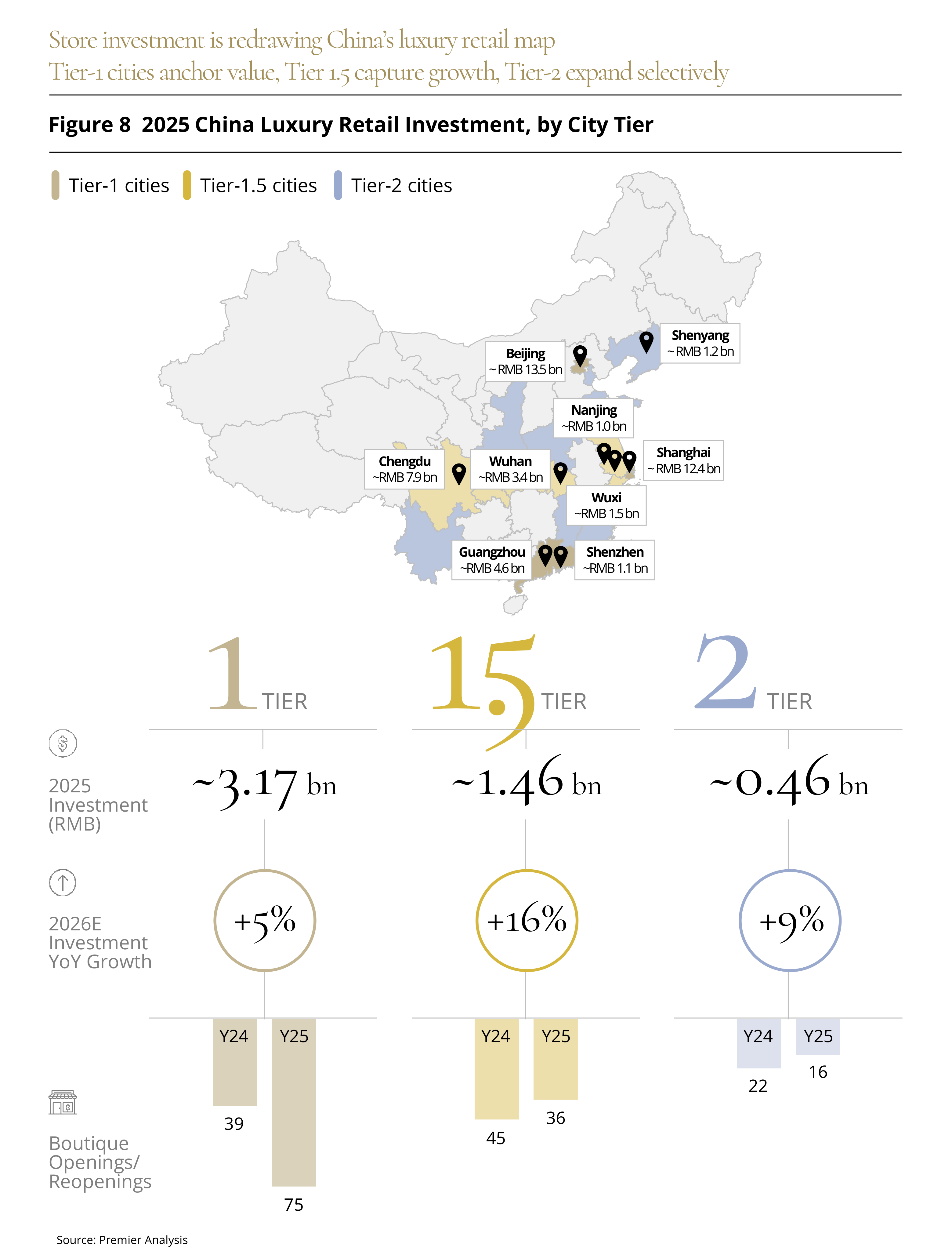
Tier 1 cities remain the primary strongholds for luxury retail investment. In 2025, total luxury retail investment reached approximately RMB 3.17 billion. Beijing recorded 30 investment projects—around 1.5 times the previous year—while Shanghai recorded 29, approximately 2.4 times 2024 levels, preserving their position as the country’s two most active hubs for boutique openings and reopenings.
Tier 1.5 cities are shifting from supplementary markets beyond the traditional Tier 1 centers into a key growth frontier for luxury. Luxury retail investment across Tier 1.5 cities reached approximately RMB 1.46 billion in 2025 and is expected to increase by around 16% year on year in 2026, signaling a selective extension of openings and reopenings into high-potential markets.
Tier 2 cities are becoming increasingly important nodes in the outward expansion of China’s luxury retail network. In 2025, luxury retail investment in Tier 2 cities totaled approximately RMB 460 million, remaining relatively limited in scale, although luxury boutique expansion had begun to extend into these markets. In 2026, luxury retail investment in Tier 2 cities is expected to grow by approximately 9% year-on-year.
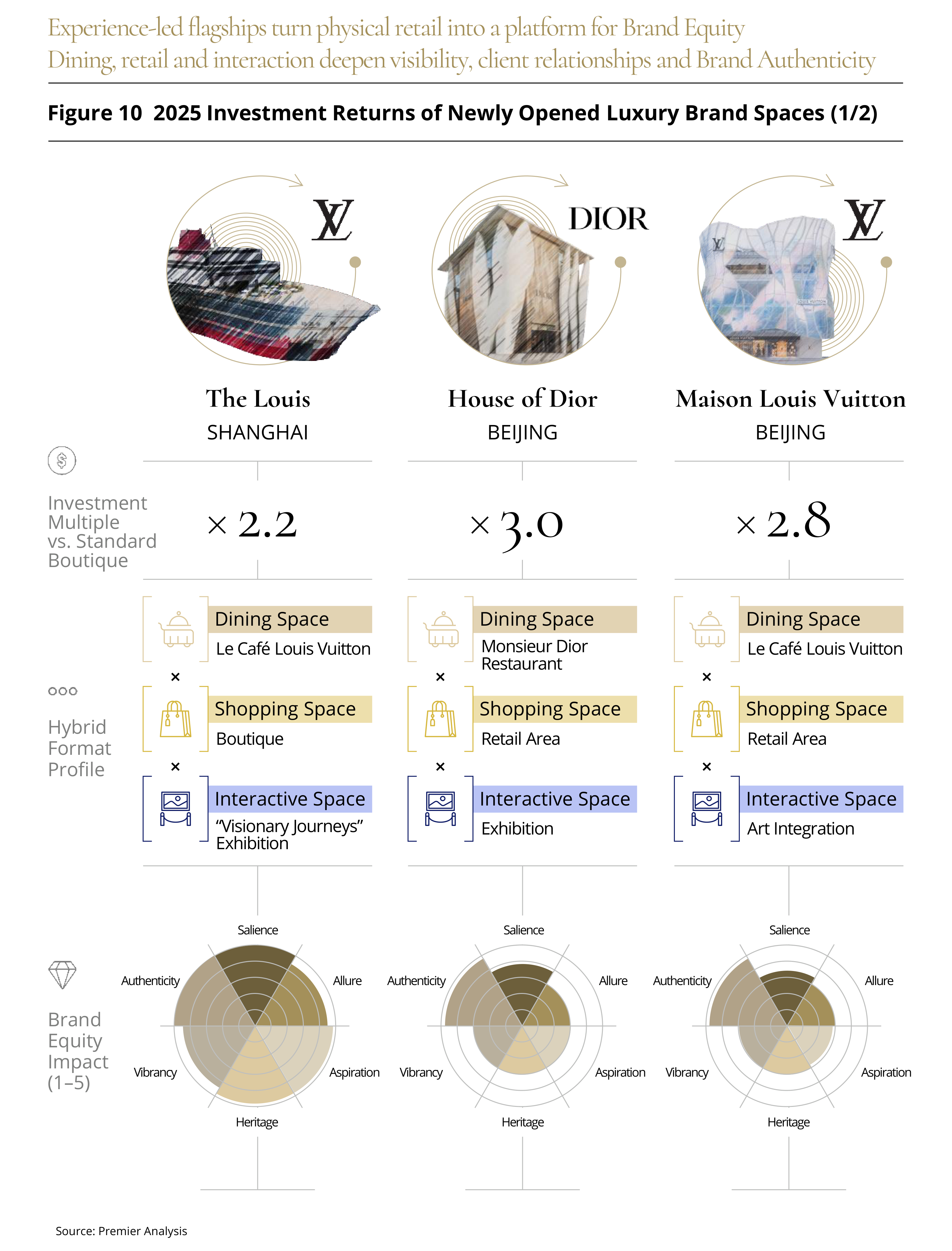
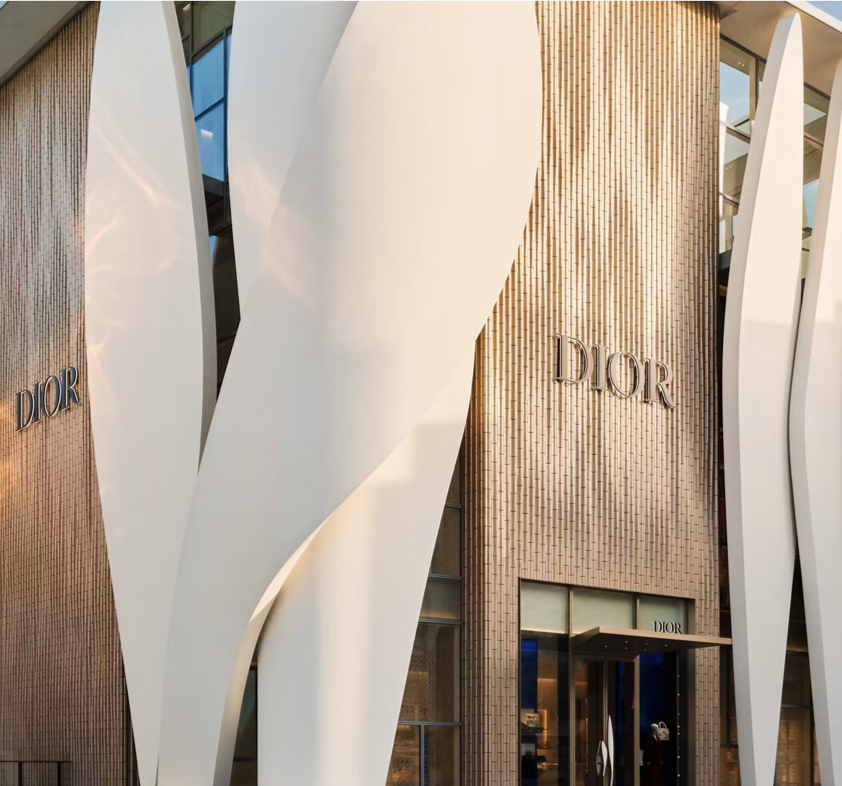
Hybrid experiential flagships are rewriting the strategic role of physical luxury retail in China. They are no longer simply stores designed to facilitate transactions, but high-specification brand environments in which architecture, cultural content, dining and retail are orchestrated as a single experience. Investment in these projects can reach two to three times that of a conventional boutique, signaling that their value is no longer measured by sales conversion alone. Their broader role is to strengthen brand image over time, deepen client relationships and make brand value tangible not only through the price tag, but through space, service and experience.
The incremental value of hybrid brand spaces does not come from a single format innovation, but from the distinct strategic roles played by different types of space. Short-cycle cultural formats such as "The Louis" in Shanghai are particularly effective at concentrating visibility and footfall within a limited period, using content-led experiences to amplify brand attention. "The Louis" records a payback period of just 1.9 years, materially shorter than the approximately 3.5-year benchmark for a standard luxury boutique.
Permanent hybrid flagships, by contrast, operate on a longer-term brand-building logic. They are not designed around short-term visibility alone, yet can continue to outperform standard boutiques across both commercial return and brand accumulation. House of Dior and Maison Louis Vuitton in Beijing deliver ROI uplifts of 5.9% and 6.4% respectively, showing that even with heavier investment and longer payback periods, large-scale hybrid flagships can generate stronger investment returns.
Hybrid brand spaces are therefore not a substitute for standard boutiques; they are redrawing the functional boundaries of offline luxury retail in China. Short-cycle cultural spaces solve for visibility and reach, while permanent hybrid flagships solve for service and relationship depth. The value of a luxury store is increasingly defined not only by how much it sells, but by whether it can convert a visit into sustained affinity—and physical space into a long-term brand asset.

04. MERGERS & ACQUISITIONS
Luxury M&A Pivots from Portfolio Expansion to Ecosystem Control
Strategic assets secure the sources of scarcity, desirability, and client access
Global luxury M&A is shifting from footprint expansion towards strategic deepening, with capital allocation focused on building deeper foundations of long-term competitiveness.
In 2025, slower growth and greater consumer caution pushed luxury M&A away from expansion for expansion’s sake and towards a more strategic role: resetting competitive position and reinforcing long-term advantage. Leading groups are becoming more restrained—and more precise—in where they deploy capital, prioritizing brand portfolios, specialist capabilities and adjacent ecosystems that can extend brand influence. Transaction completion is only the starting point. The long-term value of an acquisition ultimately depends on whether the new asset can compound into durable scarcity, brand trust and pricing power.
Brand portfolio expansion remains at the center of luxury capital allocation and accounts for the largest share of disclosed transaction value.
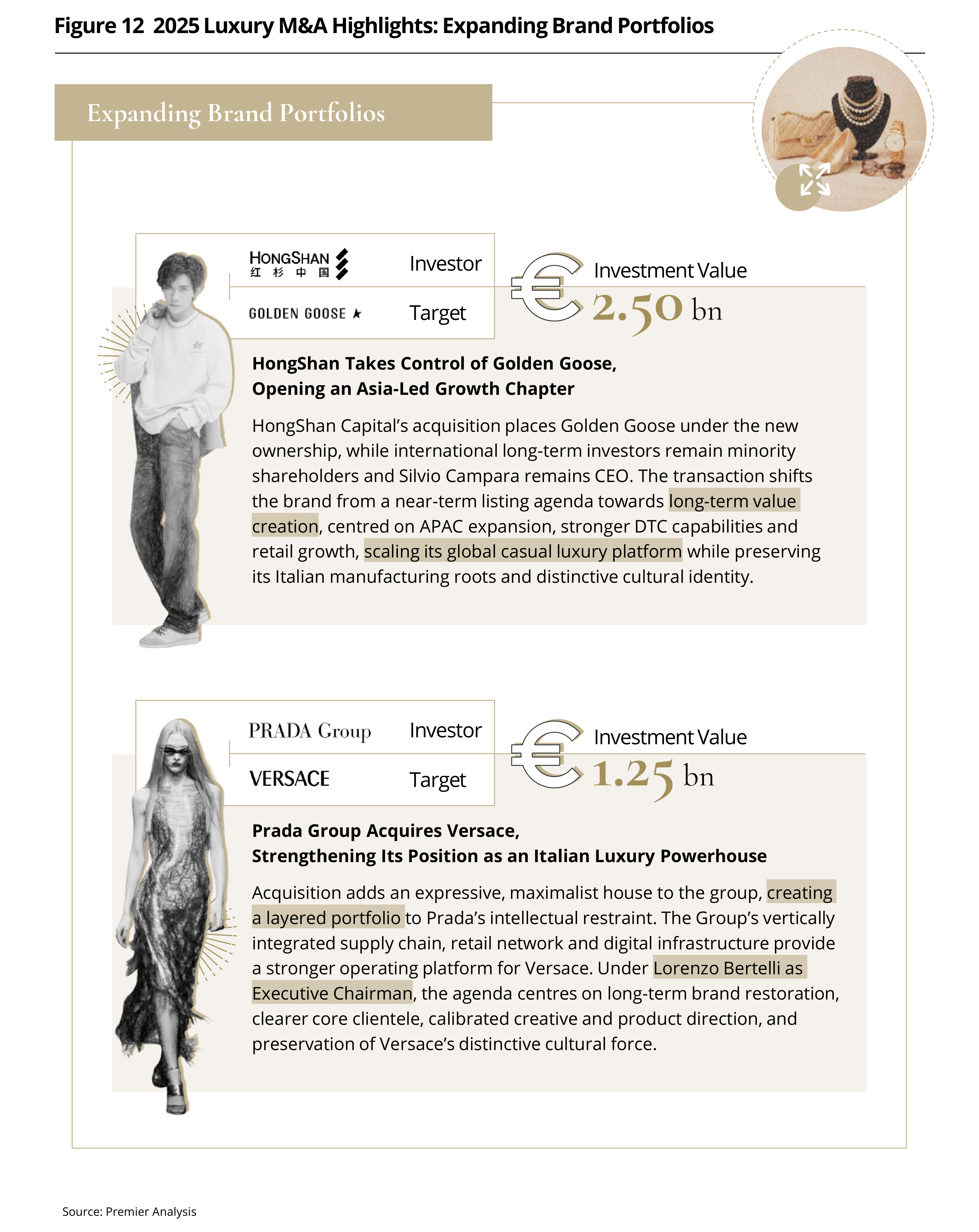
As organic expansion becomes a less sufficient growth engine for individual luxury brands, M&A remains a critical avenue for groups to build portfolio depth and extend strategic reach. In 2025, brand portfolio activity remained robust, but capital became more selective: the key question is no longer whether an asset can be added, but whether it can elevate the portfolio as a whole. Whether by adding heritage houses, acquiring distinctive niche assets or strengthening platform capabilities, portfolio expansion is moving towards a more deliberate architecture—defined by clearer roles, greater coherence and more durable sources of influence.
The long-term quality of brand-portfolio M&A will depend on whether an acquisition closes a structural gap, integrates effectively into the existing platform and opens a new dimension of value over time.
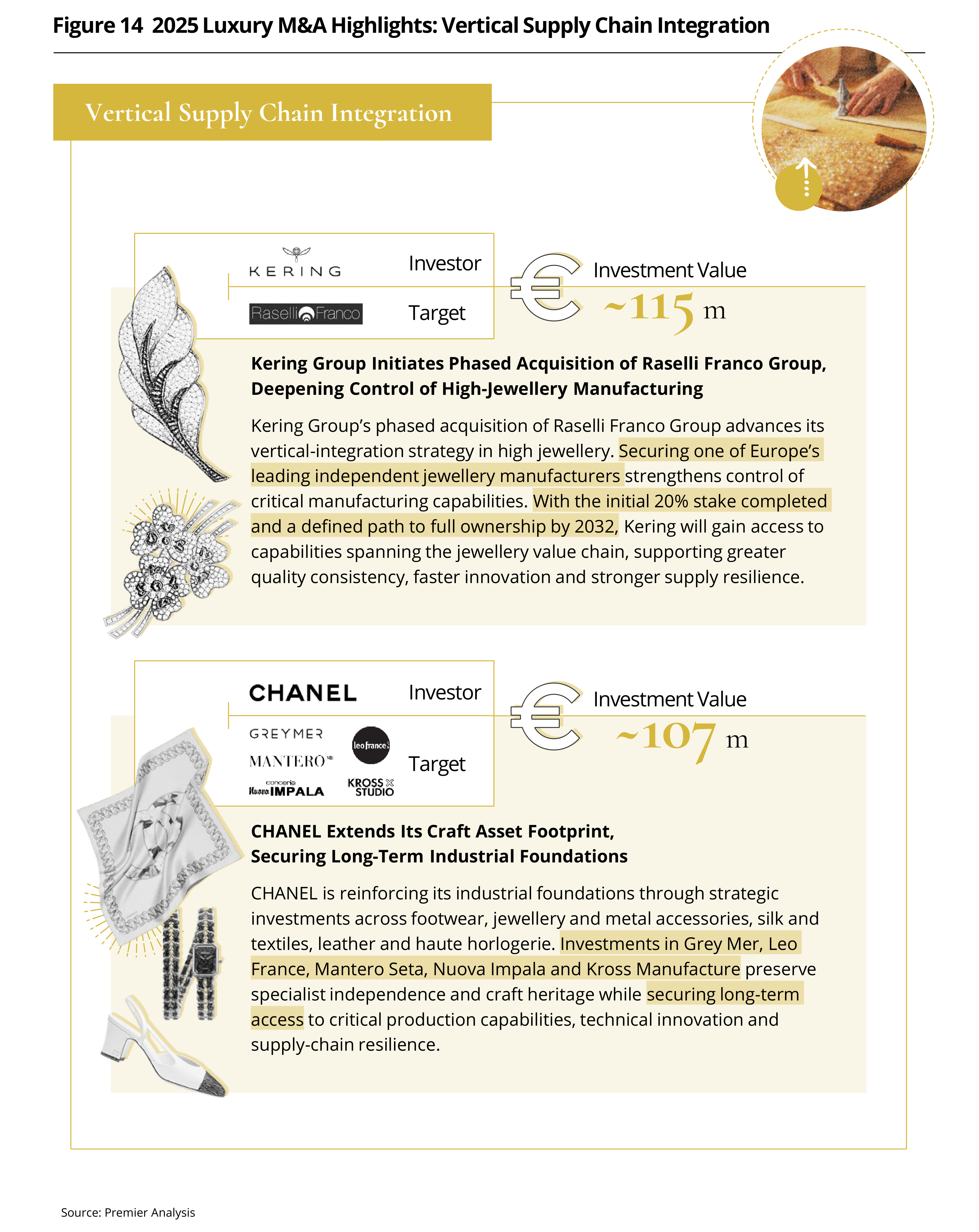
Amid softer consumer sentiment and repeated price increases that intensify scrutiny of the price–value equation, luxury brands must re-anchor premium pricing in value that is tangible and verifiable. Vertical supply-chain integration has therefore moved back to the strategic foreground. Upstream investment is no longer confined to efficiency gains or cost management; it increasingly concerns the industrial and artisanal foundations on which brand value itself depends.
As capital continues to move upstream, vertical integration extends beyond operational efficiency to become a critical pillar of brand authenticity. By deepening control over production, luxury groups can safeguard scarce craftsmanship, maintain consistency in quality and delivery, and ensure that the standards of excellence represented by the brand remain anchored in a robust industrial base. Ultimately, luxury value must be underwritten layer by layer by materials, craftsmanship, capacity and quality standards if a brand’s long-term promise of excellence is to remain credible.
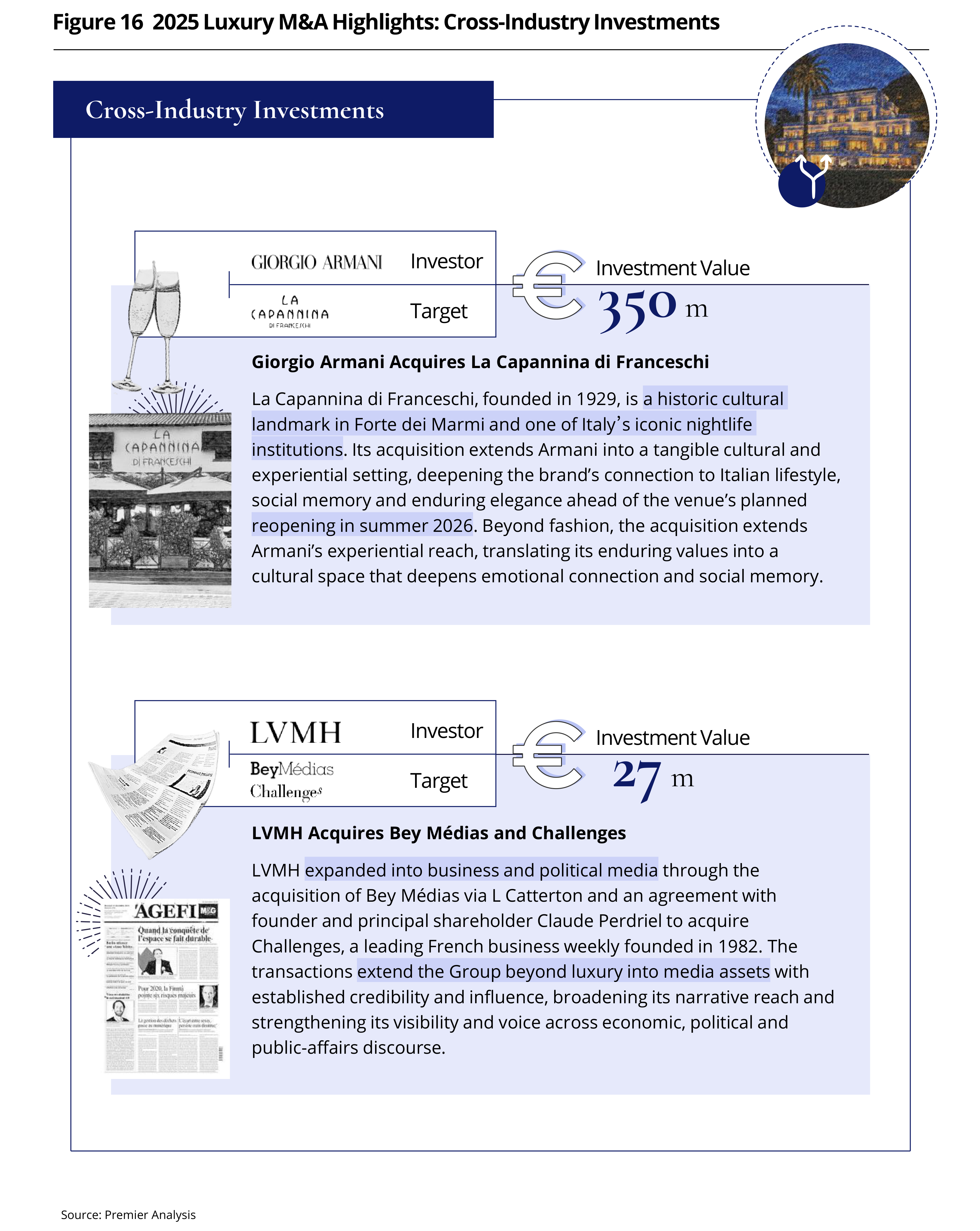
As growth across traditional product categories becomes more differentiated, cross-industry investment is assuming greater strategic weight within luxury M&A. By 2025, capital deployment had moved beyond brands and industrial assets into adjacent fields such as hospitality, real estate, media and entertainment—allowing luxury to be experienced and narrated beyond the product, and to extend more naturally into consumers’ lived environments. Hospitality and real estate remain the core destinations, underscoring the strategic value of spaces that host experience and heighten perception in building brand desirability and deepening immersion. The growing role of media and entertainment further broadens the industry’s understanding of how luxury value is formed: beyond product, cultural context, experiential space and the environment of perception all contribute to long-term brand value.
Looking to 2026, luxury cross-industry investment is expected to extend from hospitality and commercial real estate into a broader lifestyle ecosystem. Value creation is moving from the product itself towards the settings brands enter, the experiences they organize and the relationships they build with consumers.
As art and culture, wellness services and technology gain strategic relevance, cross-industry expansion is moving from isolated adjacent investments towards a more coherent ecosystem. The strategic priority will no longer be diversification for its own sake, but building relevance across the full client lifestyle journey—allowing the brand to play a sustained role across experience, culture, wellbeing and digital connection.

04. CREATIVE LEADERSHIP
Creative Succession Recasts Brand Desirability
New creative directors translate house heritage into renewed cultural magnetism
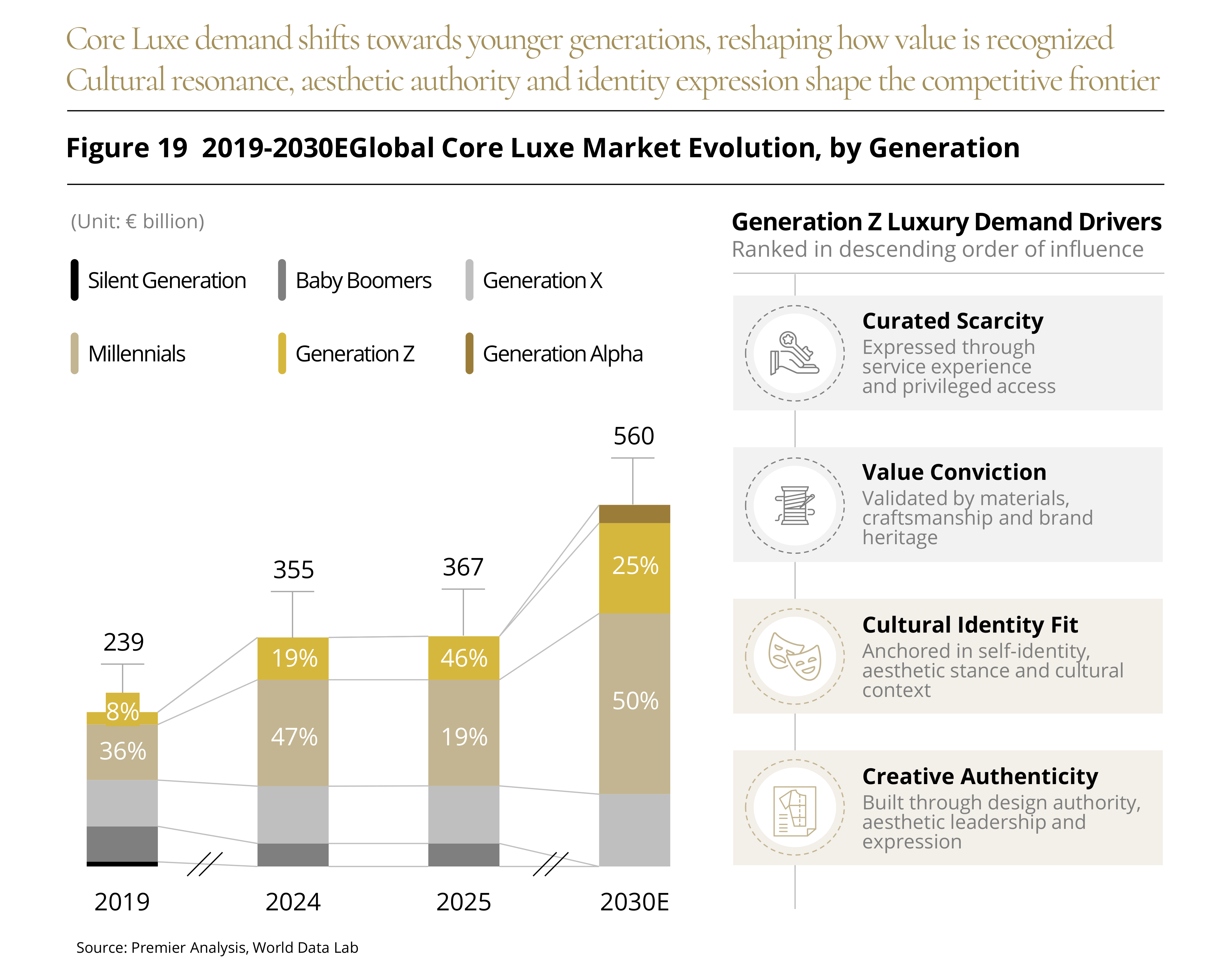
By 2030, the center of gravity in luxury demand is set to shift rapidly towards younger generations, reorganizing value creation around a new generational force.
Millennials and Gen Z are expected to account for approximately 75% of the luxury market by 2030, creating a far more explicit generational divide in how value is created. Millennials will continue to underpin the market with mature, stable purchasing power, while Gen Z—through sharper aesthetic judgement and stronger cultural sensitivity—is reshaping the symbols, aesthetics and contemporary contexts on which brand authority rests. The essence of this transition is not simply a turnover in consumer cohorts; it is a change in how luxury value is perceived, validated and trusted.
For a new generation of consumers, scarcity and craftsmanship remain foundational. Yet the competitive frontier is shifting towards a brand’s ability to create resonance between identity and cultural sentiment, while sustaining aesthetic leadership through design innovation. As luxury increasingly carries self-expression, individual choice and value alignment, cultural acuity and aesthetic authority are becoming the deepest sources of brand desirability.
The latest wave of creative director appointments is no longer a matter of leadership succession; it is a strategic signal that brands are resetting contemporary relevance and competing for aesthetic authority. Creative leadership now sits at the intersection of two capabilities: building a brand world that contemporary consumers can understand, enter and desire; and articulating an aesthetic language with sufficient clarity and authority to renew desire through heritage.
From an industry-structure perspective, the concentration of Millennial creative directors in recent appointments is not a coincidental reshuffle. It reflects the way younger consumers are beginning to shape luxury’s most fundamental creative decisions: who defines the next aesthetic direction, and who can establish cultural dialogue with a new generation. In 2025, 75% of newly appointed creative directors were Millennials, signaling that the generational shift in demand is now being mirrored by a generational renewal in creative leadership. Selection criteria are evolving as well—from a primary emphasis on pedigree, tenure and reputation towards a sharper focus on shared aesthetic sensibilities, cultural fluency and the expressive codes of the next generation of Core Luxe consumers.
The 2025 wave of appointments also marks a departure from the 2024 pattern of repeatedly rotating talent among a small circle of leading houses. Rather than cycling through a limited pool of established designers, brands are broadening the creative talent landscape and introducing new voices. Pedigree, experience and reputation still carry weight, but greater emphasis is now placed on whether a designer brings a distinctive point of view, a clearly recognizable creative identity and the ability to keep brand language in constant renewal.
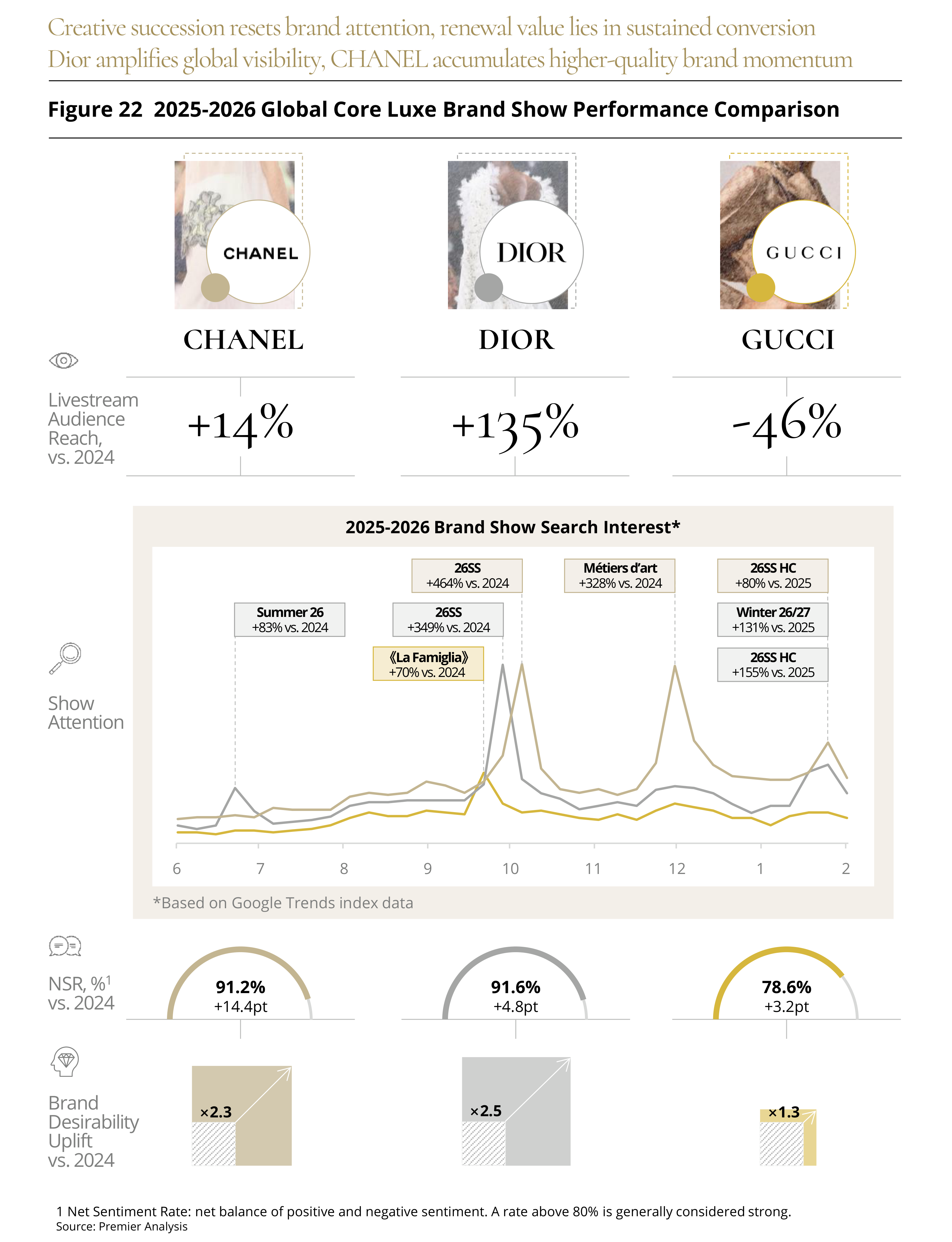
Creative director transitions are becoming a critical mechanism for luxury brands to rebuild market attention and cultural relevance. Recent performance further suggests that the value of creative renewal is being released through a more complete chain: a new aesthetic generates attention, product converts that attention into desire, and client expansion and commercial performance create a reinforcing feedback loop.
Dior quickly established global momentum following Jonathan Anderson’s appointment, and as the first designs entered the market, that attention began to receive product-level validation. In its H1 2026 results, LVMH noted that Dior’s growth was accelerating and specifically highlighted the positive market response to the Cigale handbag.
CHANEL is following a more expansive path. “Blazymania” is extending from creative heat into products, new clients and regional demand. According to Bloomberg, CHANEL’s comparable revenue rose by approximately 16% in H1 2026, with Fashion growing broadly in line with the group; all regions expanded, while sales in the US increased by more than 25%. This suggests that the current creative renewal is not merely reactivating aesthetic interest among existing clients, but widening the brand’s demand frontier—converting renewed product desirability into client recruitment, regional growth and broader commercial momentum.
Gucci remains in a more complex rebuilding phase, although the connection between creativity, product and commercial performance is beginning to recover. In H1 2026, comparable revenue remained down 5%, but the decline narrowed to 2% in Q2, with directly operated retail improving by 7 percentage points from Q1. Leather goods also returned to growth in Q2, while new products including Borsetto and Paparazzo handbags began to gain market traction. For Gucci, Demna’s distinctive creative language and cultural visibility are reopening the brand’s creative frontier. The critical test is whether this renewed aesthetic direction can gather strength across a fuller product cycle and ultimately translate into client re-engagement, restored brand authority and a return to positive growth.
The strategic value of creative renewal ultimately depends on converting renewed cultural relevance into a sustained cycle in which product desire, client expansion and growth reinforce one another. Brands with genuine advantage can compound momentum across the creative value chain: show impact strengthens product desire, product desire expands the client base, and commercial performance in turn validates and reinforces the creative direction. Creative leadership therefore extends beyond aesthetic renewal to become a key mechanism for reactivating brand equity and compounding long-term value.
06. CLIENT SEGMENT INSIGHTS
Luxury Deepens Affinity While Widening the Path In
High-touch engagement deepens top-tier affinity; Broader experiences draw emerging clients in
Luxury demand is entering a more stratified phase. Affluent clients remain resilient, while aspirational demand is weakening under pressure, concentrating growth among consumers with greater capacity to absorb premium pricing.
During the early post-pandemic recovery, industry growth was supported jointly by price increases, the return of physical luxury experiences and broad participation from aspirational consumers. By 2025, repeated price elevation, softer macro sentiment and greater consumer caution had begun to suppress entry and mid-tier demand, while high-spending clients remained comparatively resilient. Growth is therefore concentrating more heavily among consumers with stronger spending capacity, greater ability to absorb higher prices, and a stronger preference for service, scarcity and personalized experience. The result is a luxury demand structure with higher thresholds and more pronounced segmentation.
Against this backdrop, distinguishing between resilient HNWI participation, consumers progressing upwards through luxury, and more cautious aspirational participation will become increasingly important to how brands judge pricing logic, product architecture and the path of future recovery.
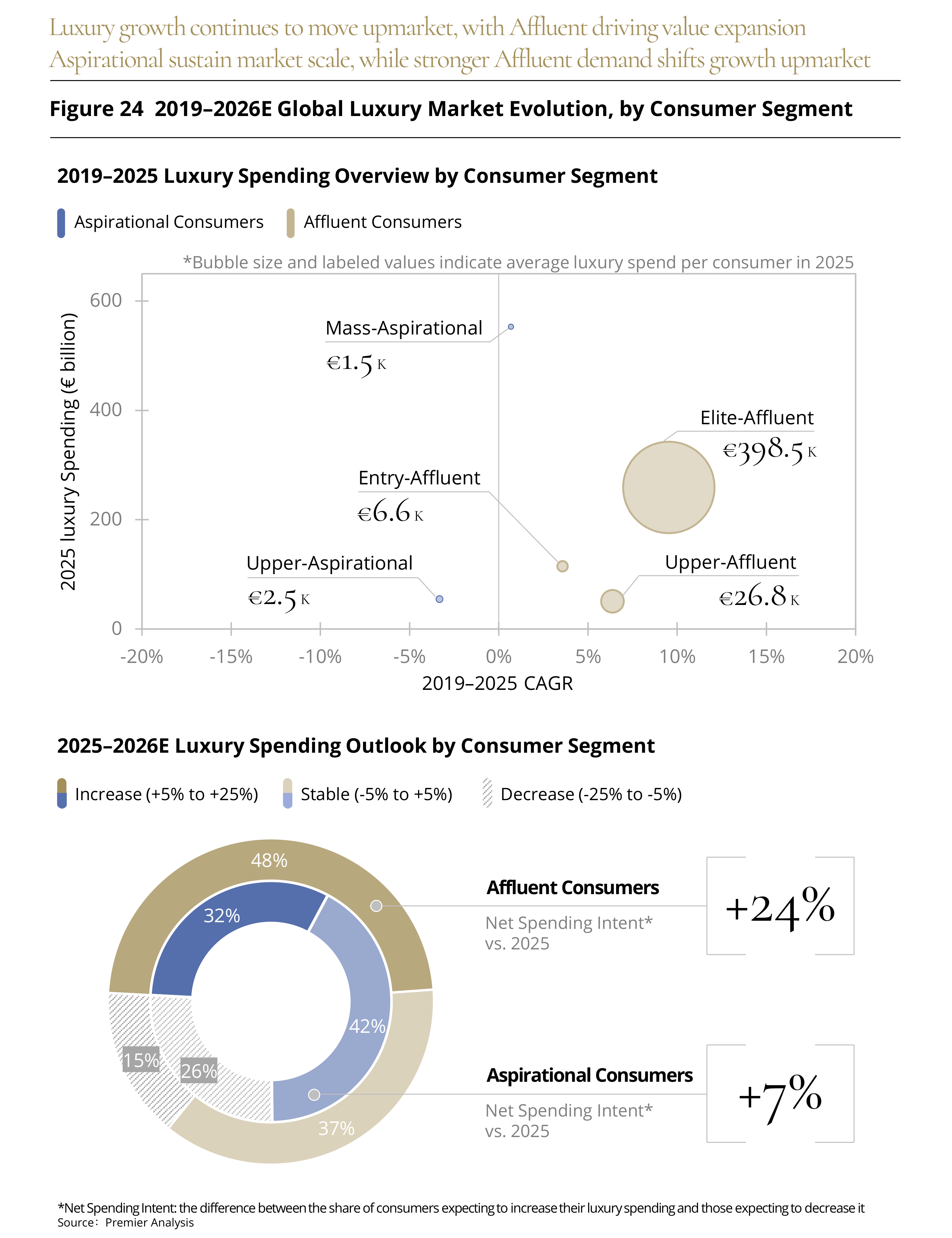
The next phase of luxury market growth is shifting decisively towards affluent consumers. Between 2019 and 2025, affluent consumers delivered the strongest growth momentum and the highest spend per consumer. Within this group, Elite-Affluent and Upper-Affluent consumers form the most resilient demand base and are emerging as the principal drivers of value expansion. Aspirational consumers, by contrast, continue to account for the largest share of total market spending, while their strategic role lies increasingly in sustaining market scale, broadening the consumer base and preserving the upward pathway through which long-term demand is renewed.
The divergence between affluent and aspirational consumers becomes even clearer in 2026 spending intentions. Among affluent consumers, 48% expect to increase luxury spending, 37% plan to maintain current levels, and net spending intention stands at +24%. Among aspirational consumers, only 32% expect to increase spending, 42% plan to remain stable and 26% anticipate reducing purchases, resulting in a net spending intention of +7%. This points to a market in which future growth will be driven primarily by value concentration at the upper end, while recovery among lower-tier consumers will depend on brands’ ability to restore a more credible alignment between price, accessibility and perceived value.
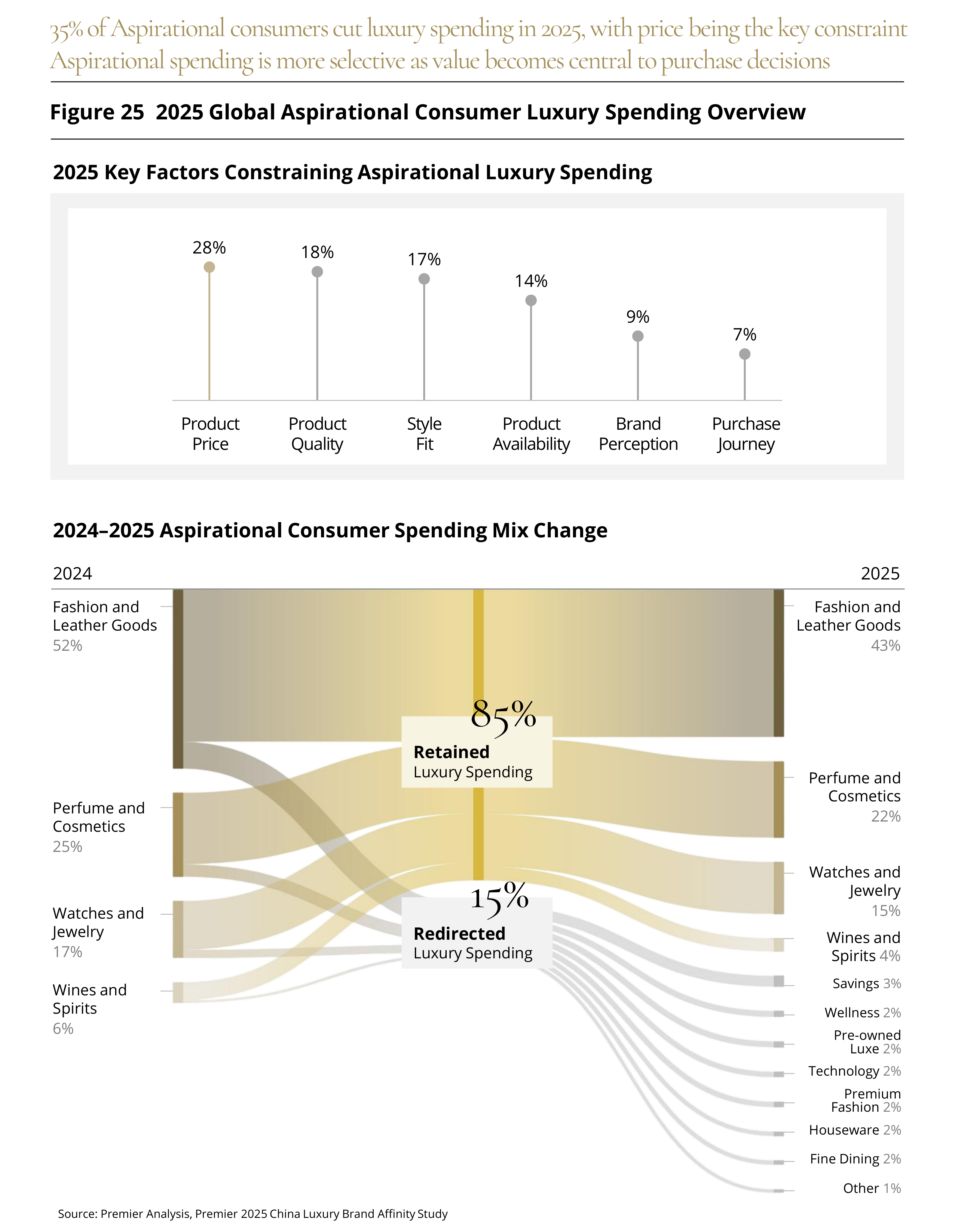
Aspirational consumers continue to underpin luxury market scale, even as purchasing momentum has weakened materially. In 2025, 35% of aspirational consumers reduced luxury expenditure, with price being the most direct pressure, followed by product quality, style fit and availability.
More precisely, aspirational spending has not left luxury, however consumers have become more selective about each purchase. The 85% retained versus 15% redirected split indicates that engagement with luxury remains substantial, while decision-making has become markedly more cautious. Aspirational demand therefore persists, but spending is more selective: consumers are less willing to pay for brand symbolism alone and are weighing price, perceived value and purchase risk more carefully.
The strategic value of this segment remains its role as a critical entry point for client recruitment, consumer-base renewal and future progression within luxury. Preserving accessible price bands and relevant product choice for aspirational consumers will therefore be essential to maintaining both the breadth of future recovery and a viable pathway for clients to move upwards over time.
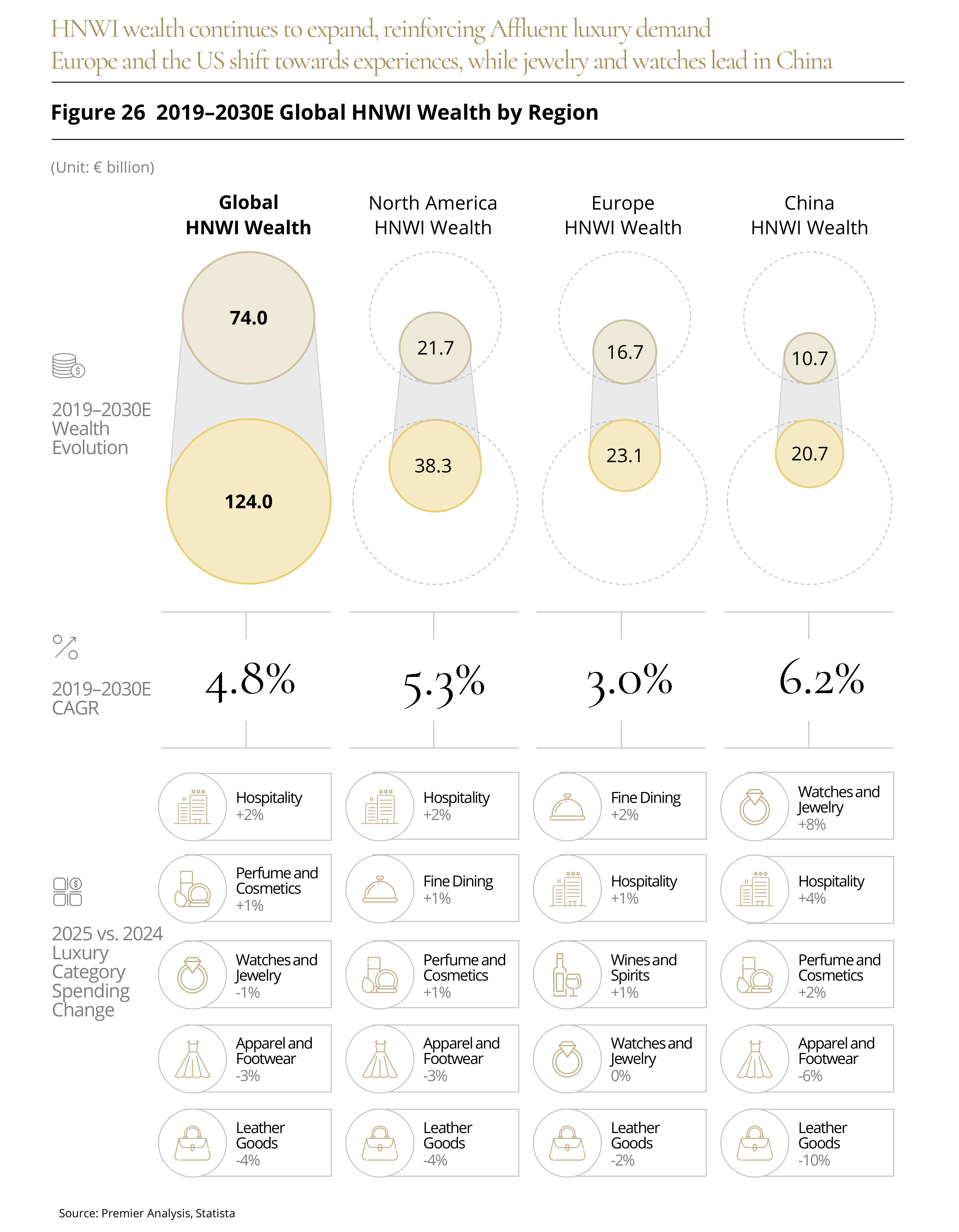
Global HNWI wealth is expected to rise from €74 trillion in 2019 to €124 trillion by 2030. China leads with a 6.2% CAGR, ahead of the US at 5.3% and Europe at 3.0%, reinforcing one of the luxury industry’s most resilient high-end demand bases. At the same time, affluent consumption is extending beyond product-led luxury into a more complete set of life contexts, with high-end hospitality, fine dining, luxury resorts and private services assuming greater weight. For these clients, the meaning of luxury is expanding from “what I own” towards “how I live, how I am served, and how elevated experiences are integrated into everyday life”.
China’s affluent consumers display a more distinctive local consumption pattern, with jewelry assuming particular strategic importance. Although spending on high-end hospitality and beauty is also increasing, the strongest momentum remains concentrated in jewelry and watches, which continue to show greater resilience than leather goods and other consumer categories. This preference reflects the combined importance of cultural symbolism, long-term value, visible craftsmanship and wearing occasions. In a cycle of more disciplined decision-making and renewed scrutiny of value, categories that simultaneously carry identity expression, cultural distinction and a sense of asset value are better positioned to earn affluent trust.
07. PRICING STRATEGY
Broad-Based Price Increases Give Way to Precision Pricing
Expanded entry points across categories unlock new demand
The logic underpinning luxury pricing is shifting from broad-based price increases towards more selective differentiation across the price architecture.
The previous luxury cycle was driven primarily by broad-based price increases, with more than 80% of incremental value coming from price elevation rather than volume expansion. In the current phase, headroom for further price-led upside is narrowing. Momentum is concentrating among resilient clients with clearer purchase intent, and across categories, products and price bands with greater capacity to absorb higher prices. Pricing authority remains intact, but it has shifted from a broadly applicable industry growth lever to a more selective and differentiated capability. Value creation is increasingly concentrating at the upper end of the price ladder, and growth is becoming more dependent on the client segments and categories where pricing power remains robust and higher prices can be absorbed without eroding brand desirability.
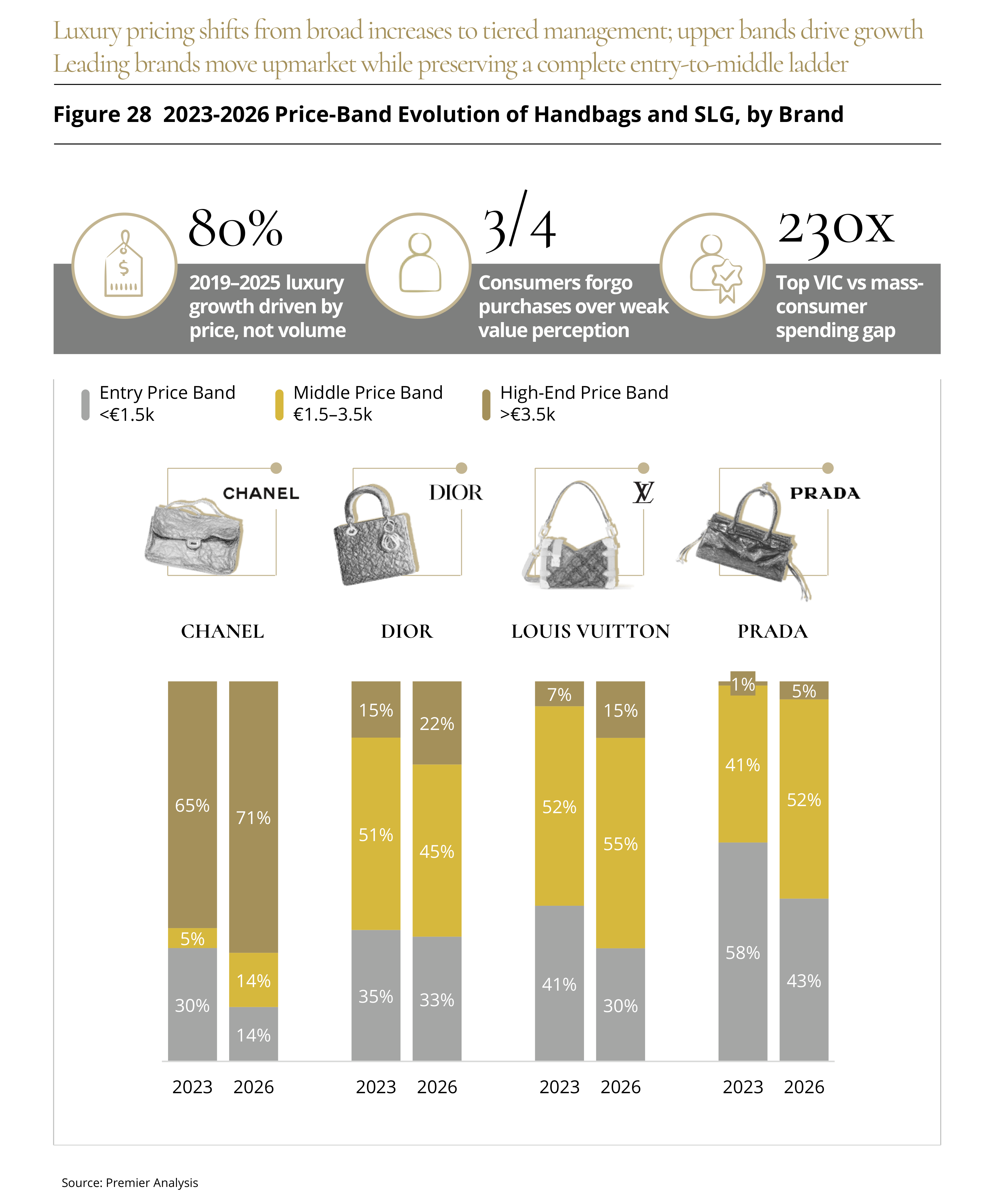
The common shifts across four leading brands point to a clear direction for the next phase of growth, with CHANEL providing the sharpest illustration. As the share of products priced above €3,500 continues to rise, the business mix is concentrating further around the brand’s most emblematic leather goods. At this level, price is no longer merely a transaction condition; it becomes an external expression of brand authority and scarcity. Dior retains a relatively complete mid-price architecture, but the overall direction remains upward. Louis Vuitton and Prada reinforce the same pattern from another angle: even as mid-price bands remain central to commercial scale, upper tiers are carrying progressively greater strategic weight.
Aspirational demand remains an essential foundation of luxury market scale. It supports not only purchasing volume, but also repeat purchase, category expansion and long-term client progression. Entry and mid-tier price bands therefore remain indispensable to the luxury business model: preserving brand accessibility, sustaining purchase continuity and creating space for clients to migrate towards higher-value tiers over time. Upper tiers define the ceiling of brand value, while entry and mid tiers sustain scale and client relationships. A mature pricing architecture allows different consumer segments to enter at the right level and progress upwards, expanding commercial value while preserving the hierarchy, substance and stature a luxury brand must retain.
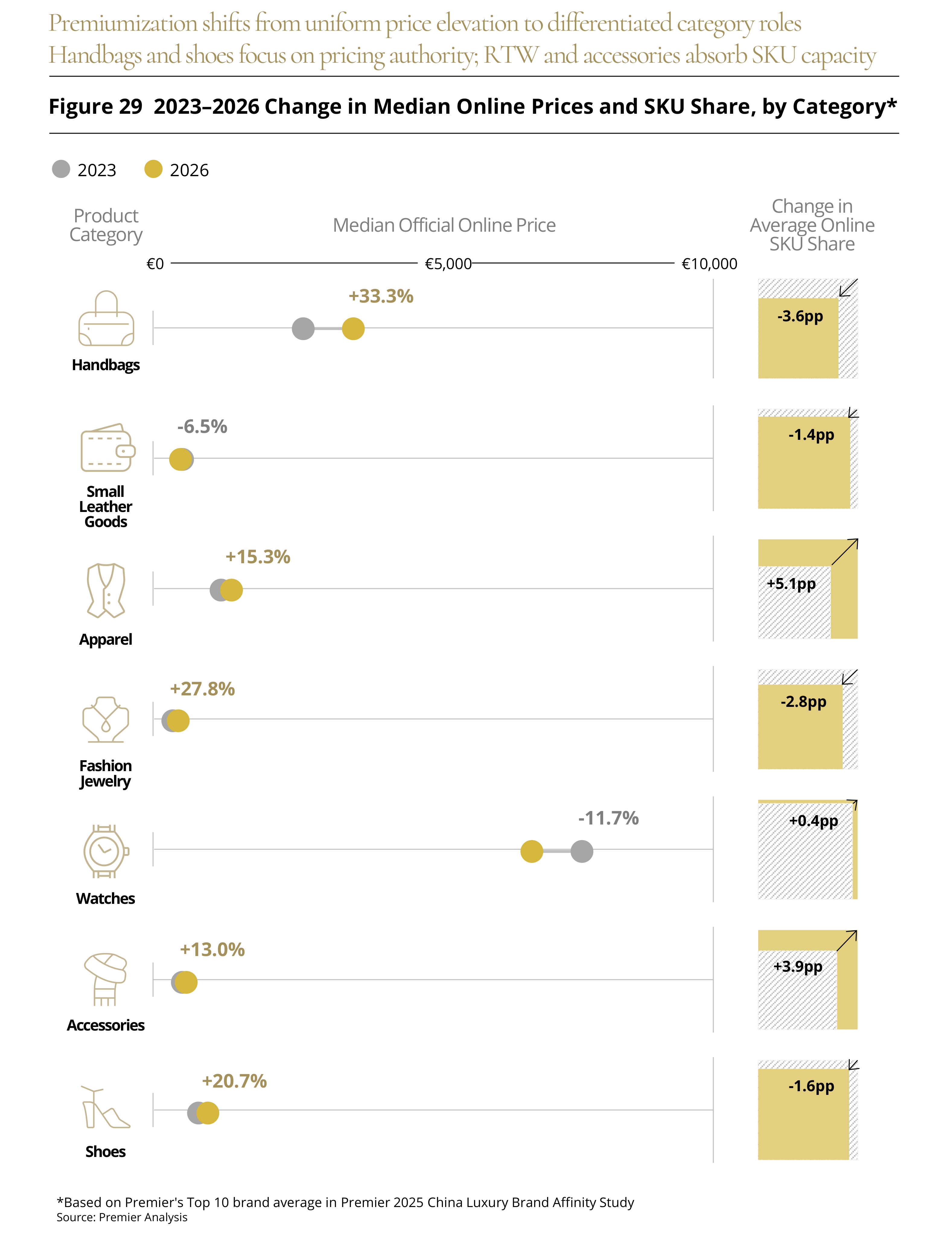
As the vertical restructuring of price bands matures, premiumization is entering its next phase: from moving the price ladder upwards to allocating merchandise more precisely across categories.
Handbags make this transition most visible: the priority is no longer to offer more choice, but to allow fewer, stronger core products to carry a greater share of value and demand. Ready-to-wear and accessories perform a different but equally important role—continually creating reasons for consumers to re-enter the brand. Some categories deepen value, while others widen demand—a division of labor that is producing a more precise portfolio-growth model than synchronized price increases across all categories.
Premiumization is therefore moving beyond price management into a deeper contest over portfolio productivity. The quality of the next growth cycle will depend on whether brands can assign clear, complementary value roles to different categories and integrate price, merchandise capacity and client pathways into a coherent growth architecture.
08. TECHNOLOGY ENABLEMENT
AI Moves Beyond Efficiency to Orchestrate Brand Relationships
Brand-specific models unite client signals and advisor judgement, enabling personalized service and commercial action
Luxury technology investment is entering a new phase of strategic evolution, with industry priorities shifting from channel digitization towards intelligence-led value creation.
By 2025, 37% of luxury technology investment was directed towards new and emerging technologies, broadly in line with manufacturing and FMCG, signaling a clear shift from foundational digitization towards the development of new capabilities. The next competitive frontier will be defined by whether technology can translate into tangible value across products, services and client engagement. With 60% of brands planning to increase technology budgets by at least 5% over the next two to three years, the direction of travel is becoming clearer and resources are beginning to accelerate towards the capability build required for the next phase.
Brands are also beginning to rebalance where incremental investment goes, with more resources moving towards data architecture, AI-enabled clienteling and demand forecasting. The objective is to convert broader channel reach into sharper demand sensing, richer preference intelligence, more seamless service delivery and stronger long-term client relationships.
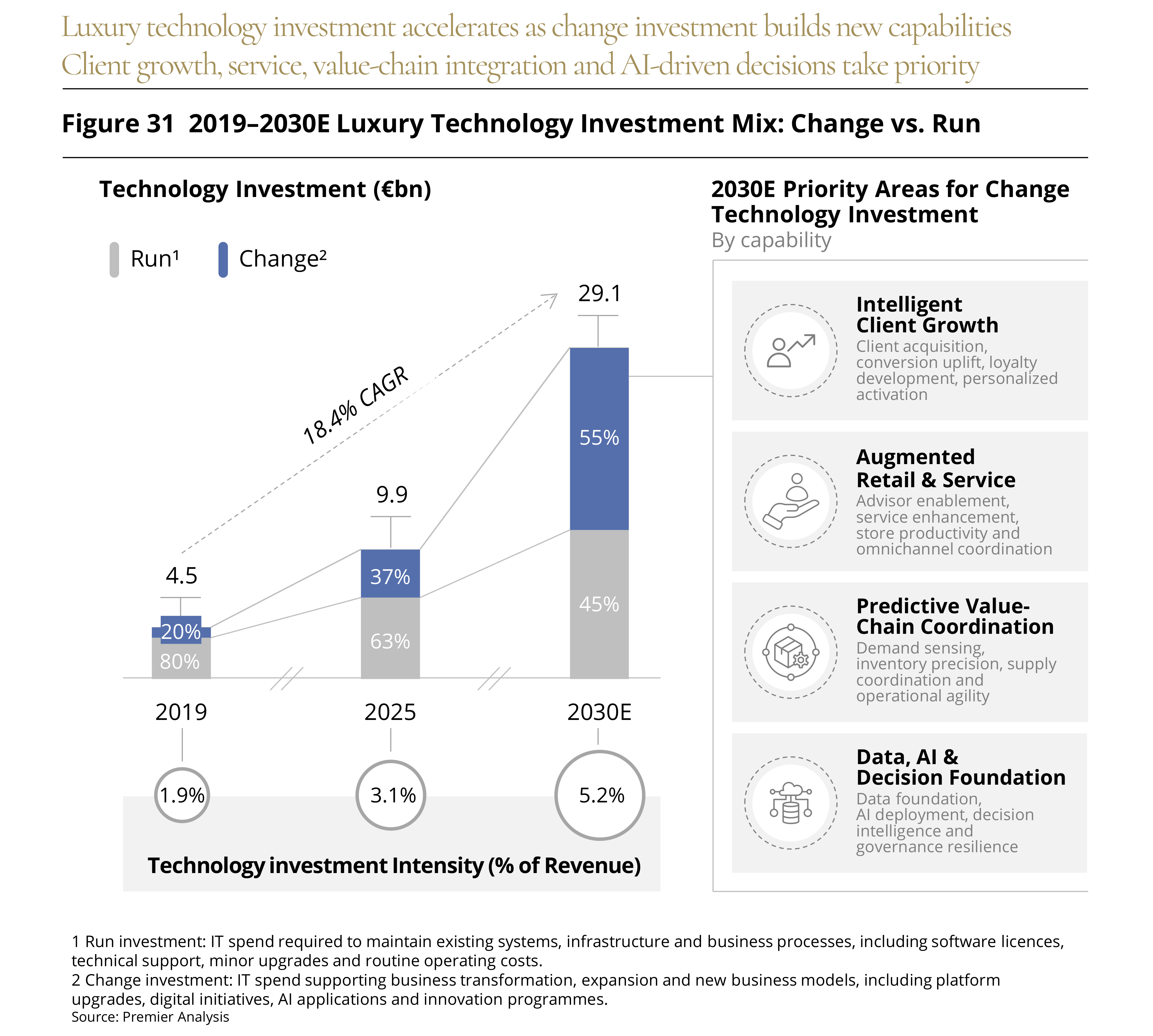
Luxury technology investment is entering an expansion phase anchored in commercial returns. Industry technology spending is projected to rise from €4.5 billion in 2019 to €29.1 billion by 2030E, with investment intensity reaching 5.2% of revenue and change investment accounting for 55% of the total. As investment scales, the logic of capital allocation is becoming more explicit: the ability to stimulate demand growth, deepen client relationships and improve operational performance is increasingly determining which technology initiatives move to the top of the investment agenda.
By 2030, luxury technology investment is expected to concentrate more heavily on the points where demand conversion and operating performance can be improved. AI is also moving from experimentation into everyday application, shifting the basis on which its value is assessed from novelty to realized outcomes: whether it improves the quality of judgement and execution across the commercial value chain is becoming a more important measure than how new the technology itself appears.
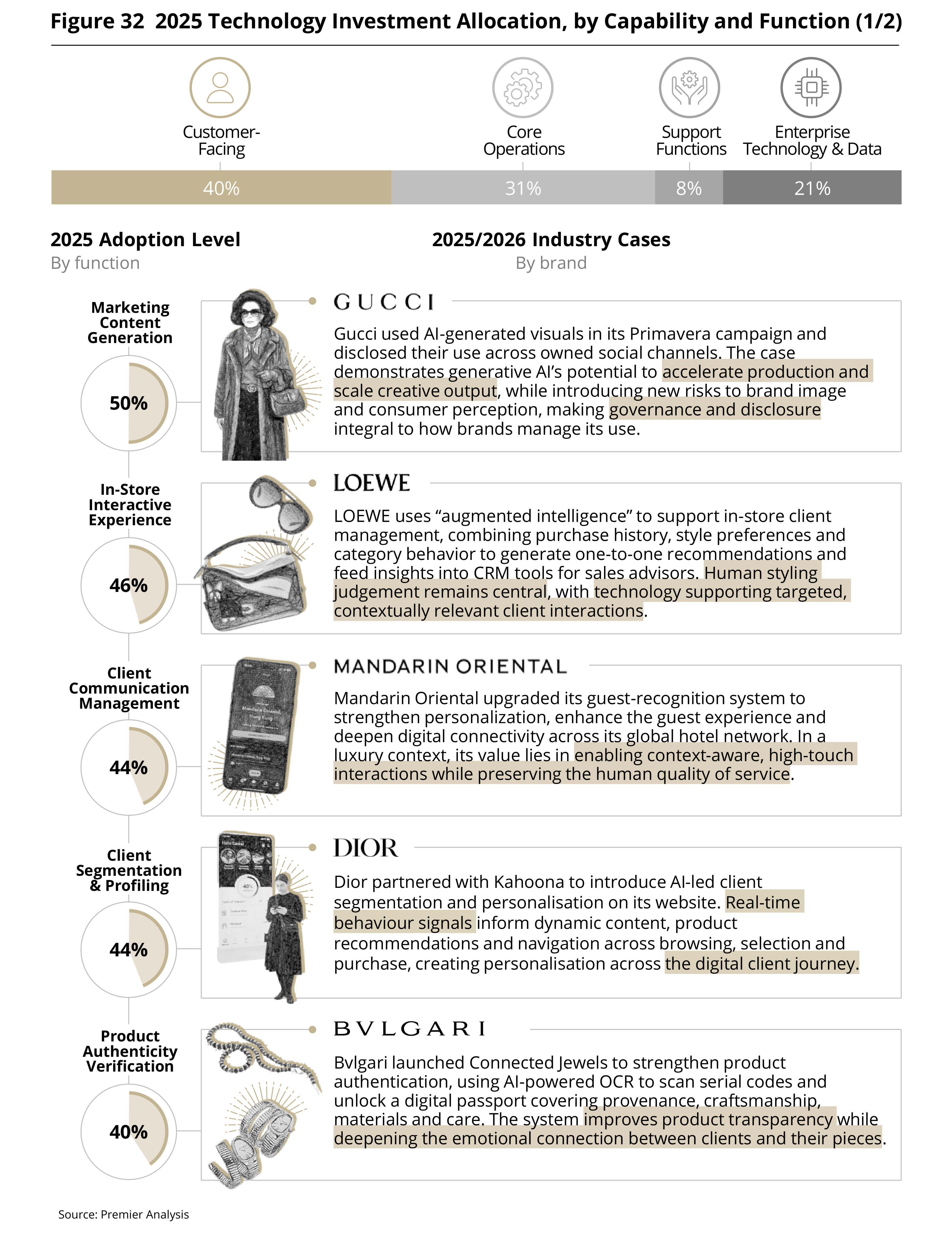
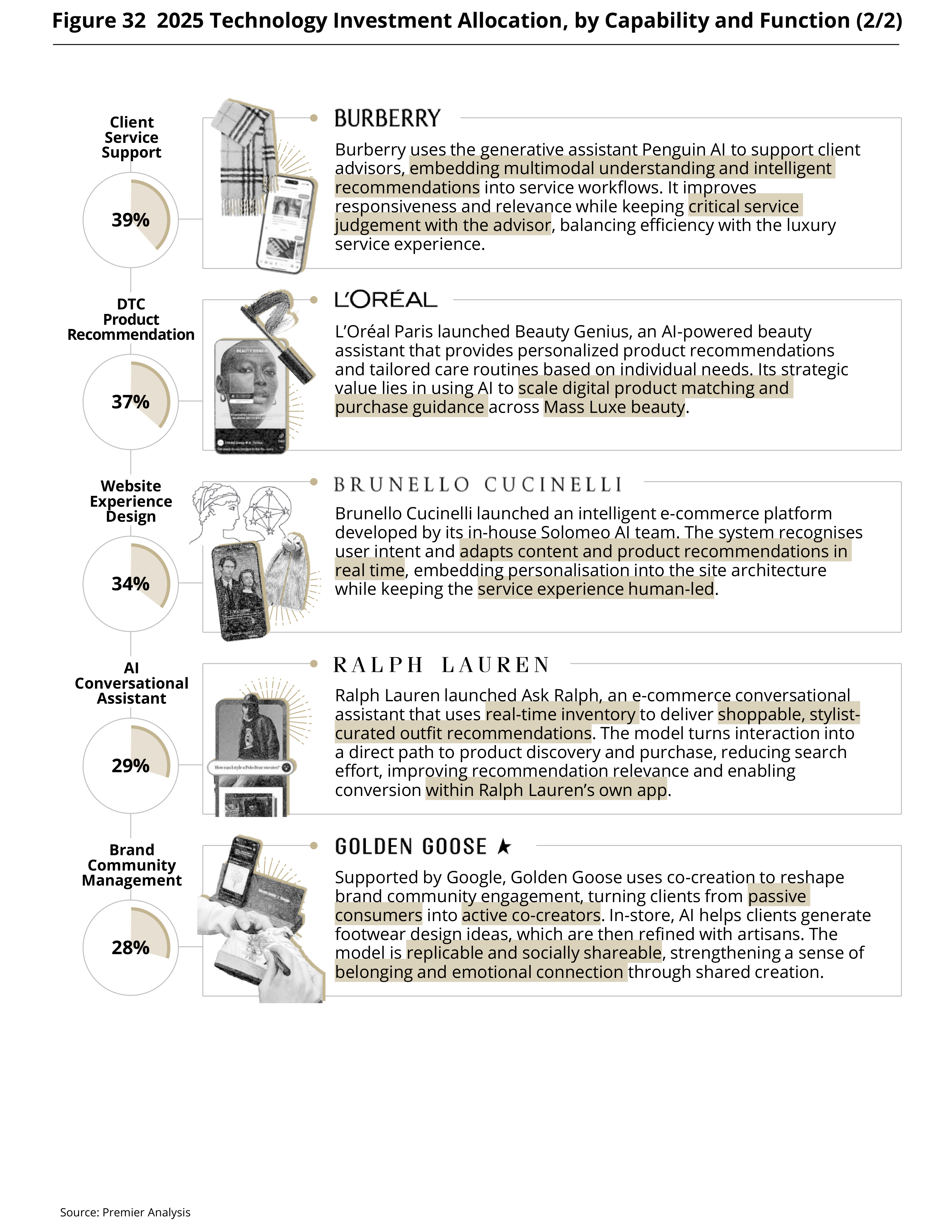
In 2025, client-facing functions remained the largest destination for technology investment, accounting for 40% of the total. More importantly, adoption declines as AI moves closer to direct client interaction. This suggests that the pace of deployment is shaped not only by technological maturity, but also by deliberate judgement around experience boundaries and potential risk.
Across the use cases already generating the strongest commercial returns, a clear deployment logic is emerging: AI sits beneath the service layer, strengthening information integration, judgement and responsiveness at advisor level, while the experience perceived by the client remains human-led. Burberry’s use of Penguin has delivered a 24% uplift in average transaction value, while Dior’s use of Kahoona has generated a tenfold increase in conversion; in both cases, AI operates behind advisor workflows rather than directly in front of the client.
The next competitive gap will depend on whether brands can make AI serve the foundations of value that are most distinctive to them. Broad deployment detached from brand logic will ultimately become an industry standard rather than a source of durable advantage.
Affinity at the Core,
Revving Up Brand Value Renewal

Authentic Value Renewed:
25/26 PRMC Luxe Index
Review & Prospect

Brand Activation Review:
January–April 2026
The Irreplaceability Imperative:
Defining Luxury’s Next Era of Growth
Luxury Industry Outlook 2026
Oct 26, 2026
Eight key trends provide luxury brands with a strategic course at a moment when growth is diverging and sources of value are shifting at speed—moving the industry from scale expansion towards deeper value creation, and rebuilding irreplaceability through the Foundations of Brand Meaning, the Magnetic Pull of Brand Desirability and the Depth of Brand Affinity to unlock the next cycle of high-quality growth.
Irreplaceability is not a new rhetoric for luxury. It is the defining imperative of its next growth cycle.
In 2026, the global luxury market is expected to grow by 3.0%. Yet that growth will no longer accrue evenly across categories, consumer segments or brands. Experiential luxury is projected to expand by 4.1%, while the core personal luxury goods segment is expected to grow by only around 0.5%. Nearly half of affluent consumers still intend to increase their luxury spending; among aspirational consumers, fewer than one in three plan to do the same. Demand has not receded. It is becoming more discriminating about where it goes. Consumers still aspire to luxury, but are less willing to pay for symbolism alone—and more exacting in the questions they ask:
What makes a product worth its price? What makes an experience endure in memory? And what makes a brand worthy of a lasting place in one’s life?
More than 80% of the industry’s growth in the previous cycle came from price increases rather than volume expansion. Price once amplified value; today, it increasingly puts value to the test. When product innovation, artisanal excellence, service experience and cultural creation fail to advance in concert, higher prices cease to attest to scarcity. Instead, they expose the unresolved value gap between a brand and its clients. The predicament confronting luxury is therefore not merely how to restore purchase. It is how to become, once again, the choice that cannot readily be replaced.
It is against this backdrop that Premier sets out the Eight Luxury Trends for 2026. They begin with an examination of diverging growth trajectories and shifting sources of value, yet collectively point towards a more fundamental question: how can brands rebuild the foundations of meaning, renew the magnetic pull of desirability and deepen the bonds of affinity—fortifying preference among existing clients, engendering it among new ones and, step by step, becoming irreplaceable?
This requires brands to restore three essential foundations.
The first is the Foundation of Brand Meaning. Materials, craftsmanship, creativity and quality remain the inalienable origins of luxury value. Heritage becomes consequential only when it is reinterpreted through contemporary products. Craftsmanship acquires meaning only when it can be genuinely perceived by the client. Promises become credible only when they are repeatedly honored across purchase, use, care, repair and service. Only then can narrative accrue into reputation, and rarity mature into trust. Price is no longer a surrogate for value, but the consequence of value fully conceived and consistently delivered.
The second is the Magnetic Pull of Brand Desirability. Luxury is expanding from something one owns into a world in which one participates. The growing share of expenditure devoted to travel, gastronomy, art, wellbeing and private experiences does not imply that the product has lost its centrality. Rather, it reveals a deeper meaning of luxury: people are not merely purchasing an object. They are choosing how their time is spent, how their relationships are cherished and how the self is understood. What brands must contend for, therefore, is no longer merely share of wallet, but share of life—not only a place in the client’s wardrobe or collection, but a place in how they imagine and define a life well lived.
The third is the Depth of Brand Affinity. Irreplaceability must be deepened among existing clients and cultivated among new ones. For established clients, brands must transcend episodic transactions and short-lived loyalty. They must remain relevant as life stages, everyday contexts and personal values evolve, giving clients continual reason to reaffirm: “Why do I still choose this brand?” For a new generation of consumers, it is not enough to offer more accessible products or lower points of entry. Every first encounter must open into a deeper understanding of value, a stronger sense of identification and a progressive relationship with the brand—until consumers come to understand: “Why will nothing else do?”
Irreplaceability must therefore be embedded in the operating system of the business; it cannot remain confined to brand narrative or communication. It requires retail to move from expansive proliferation to the exacting stewardship of strategic assets; capital to shift from portfolio expansion towards control of the core ecosystem; and creativity to transcend the impact of a single season and become a brand-wide interpretive force. It also requires price architecture to return to the logic of value creation, client development to sustain long-term progression, and AI to evolve from back-office efficiency into relationship intelligence. The eight trends examined in this report are manifestations of the same profound transition: from expanding the perimeter to fortifying the core; from competing for visibility to creating irreplaceability.
The next cycle of growth will no longer reward, indiscriminately, the brands that speak louder, open more stores or raise prices more frequently. It will flow towards those capable of both safeguarding the value roots of luxury and entering the lived realities of their clients—giving established clients renewed reason to affirm, “Why do I still choose this brand?” while enabling new ones to understand, “Why will nothing else do?”
The ultimate expression of irreplaceability is not simply to remain seen, considered or purchased.
It is to move from one choice among many to the choice—
And, as time unfolds, the only one.

Shanghai
11/F · WSH Building
POLY GREENLAND PLAZA
198 Jingzhou Road
Shanghai PRC · 200082
London
OFFICE SUITE 29A · 3/F
23 Wharf Street
London England · SE8 3GG
Hongkong
9/F · Tower A
NEW MANDARIN PLAZA
14 Science Museum Road
Hongkong SAR · 999077