
Luxe OS | Global Luxury
Brand Activation Review:
January–April 2026
Luxe OS | Global Luxury
Brand Activation Review:
January–April 2026





Luxe OS | Global Luxury
Brand Activation Review:
January–April 2026
Oct 26, 2026
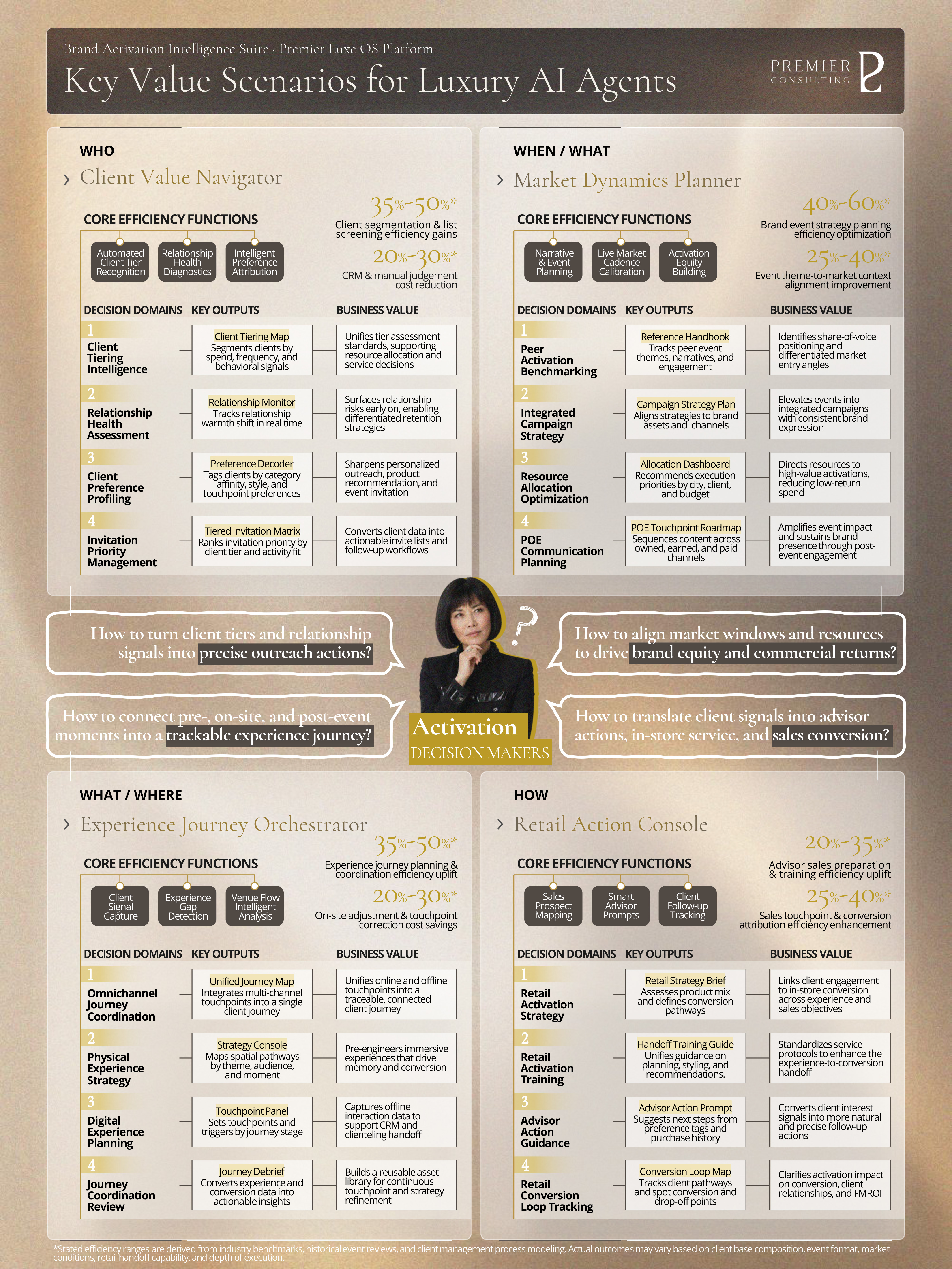
Powered by its proprietary Luxury OS Platform, Premier has launched the Brand Activation Intelligence Suite, an AI agent designed to distill key mechanisms and consolidate core signals across luxury brand activations, translating fragmented event performance, market signals, and client feedback into identifiable, sustainable, and reusable decision assets that support an intelligence-led approach to luxury activation management.
From January to April 2026, global luxury brand activations continued to intensify, with rising activation density, refined experiential sophistication, and precise client engagement. Across fashion shows, private client experiences, pop-ups and limited-time spaces, boutique openings/reopenings, brand exhibitions, and collection previews, luxury houses are moving beyond standalone moments of visibility, elevating activations into multi-dimensional value platforms where client relationship-building, cultural narrative, and commercial momentum converge.
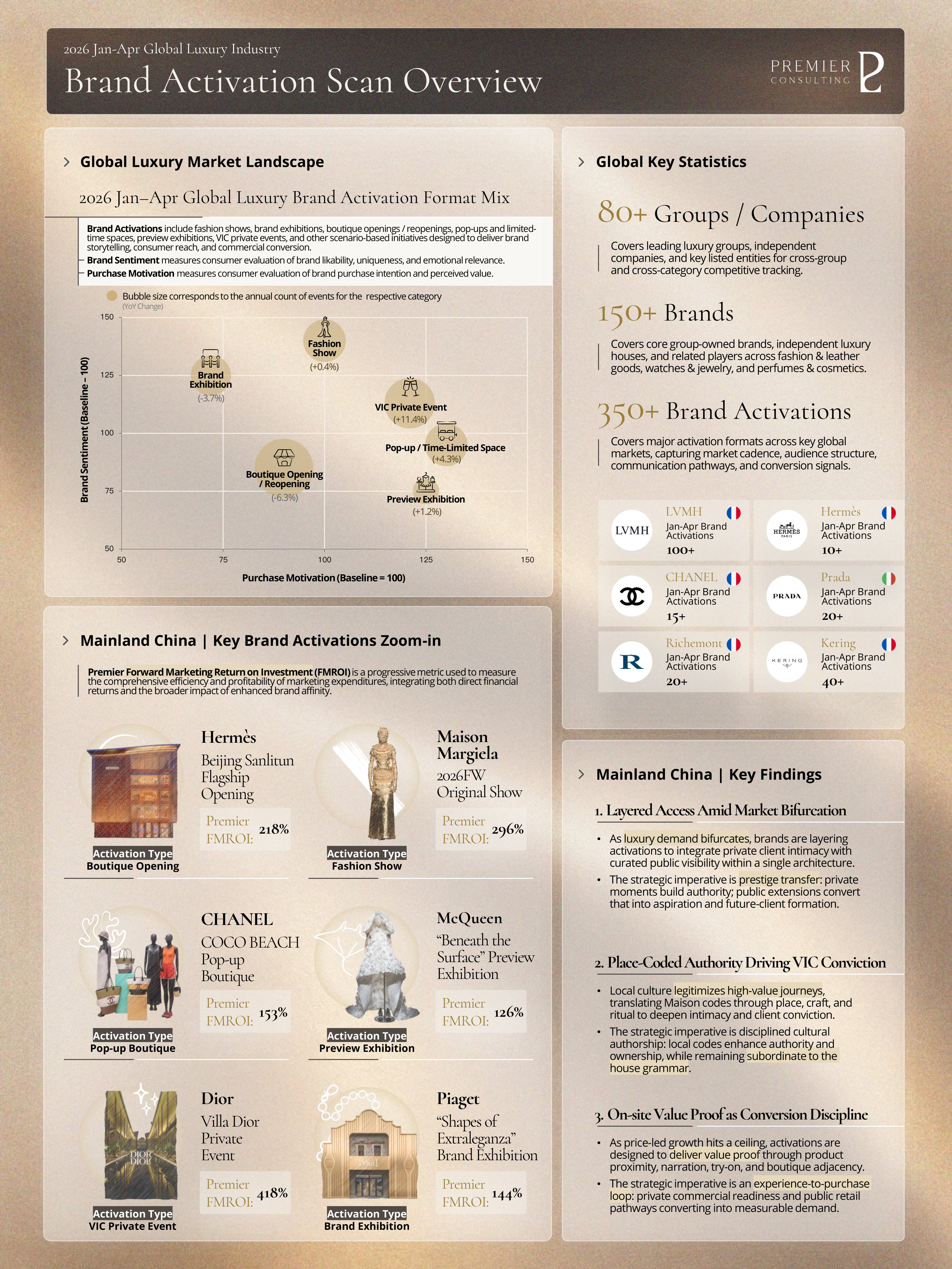
Based on Premier’s continued monitoring of 350+ brand activations, 150+ brands, and 80+ groups / companies, the review consolidates a systematic and structured analysis of global luxury brand activations in the first four months of 2026. The analysis is designed to look beyond the surface momentum of event activity and decode how leading houses design access mechanisms, mobilize cultural contexts, and move clients from aspiration to action within the experiential field.
In Mainland China, as luxury consumption enters a selective and disciplined cycle, brand activations are showing stronger curatorial discipline, sharper audience architecture, and an intentional orientation toward client cultivation.
First, layered access architecture is becoming the underlying operating order. As the needs of affluent clients and aspirational audiences continue to diverge, brands are building deliberate mechanisms of segmentation, entry, and handover through VIC private experiences, targeted invitations, public-facing visibility, and retail extension. Dior deepened relationships with top-tier clients through its Villa Dior private event in Suzhou, while CHANEL’s COCO BEACH limited-time space in Shanghai connected brand aspiration, public reach, and retail conversion within a single activation architecture.
Second, local culture is moving beyond narrative expression to become embedded within the client journey. Through place, craftsmanship, architecture, art, and urban memory, brands are reconstructing the symbolic and experiential meaning of activation spaces. Hermès developed a spatial narrative around city culture through its Beijing Sanlitun flagship store, while Dior incorporated Kunqu Opera, Suzhou embroidery, incense-making, bamboo weaving, and other local cultural elements into the Villa Dior Suzhou private event journey, allowing clients to encounter a sensorial and emotionally resonant form of cultural belonging.
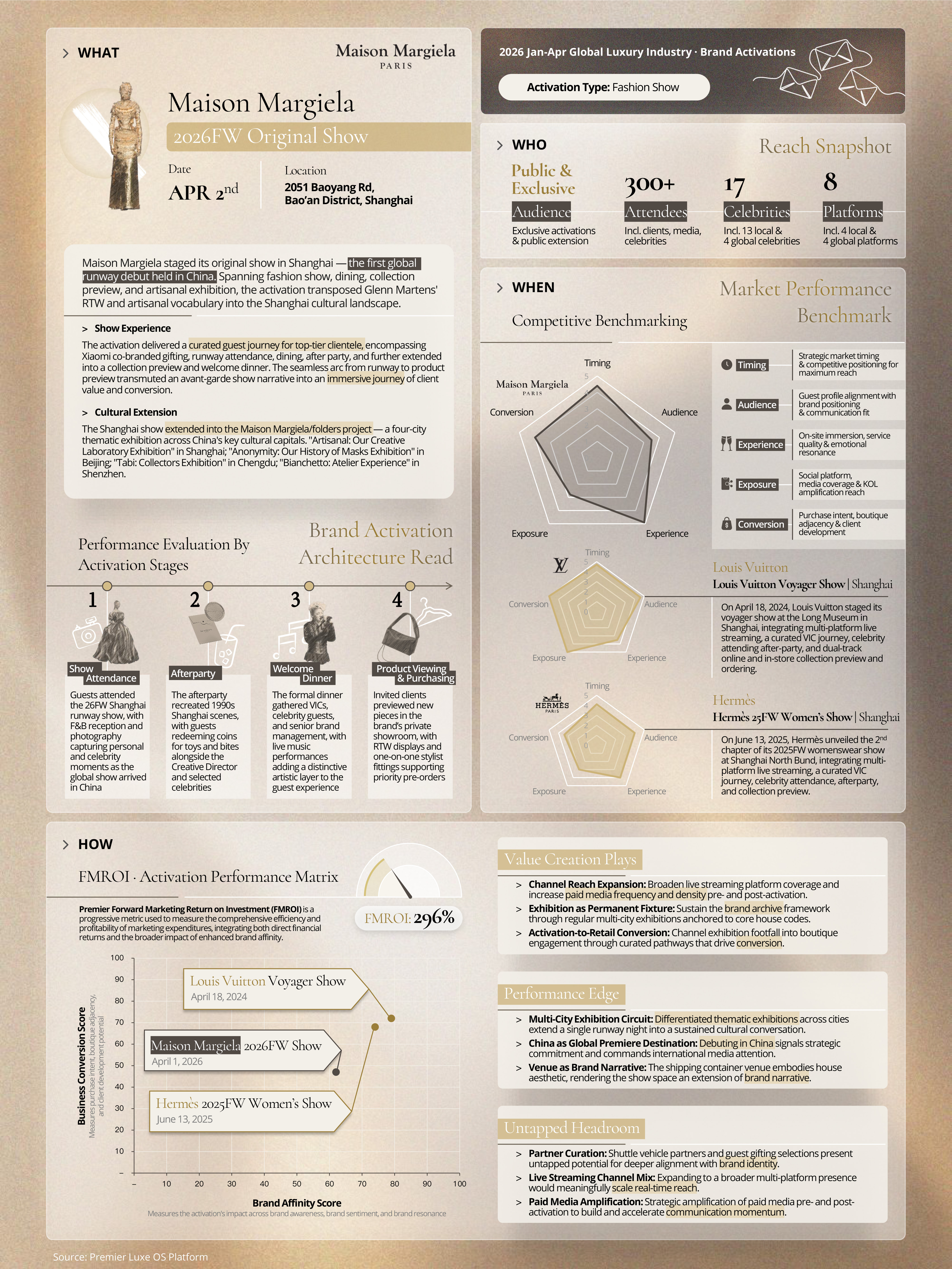
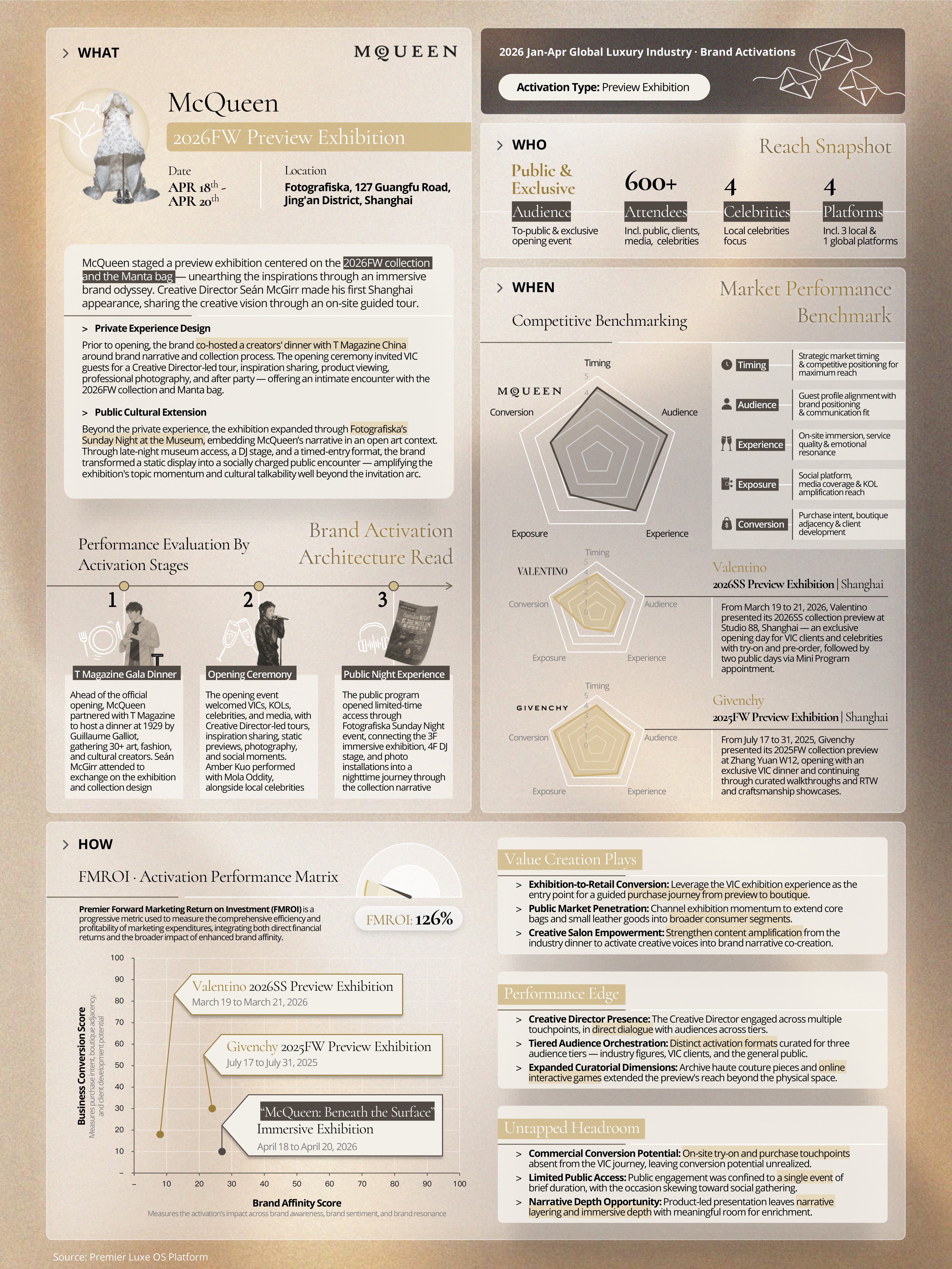
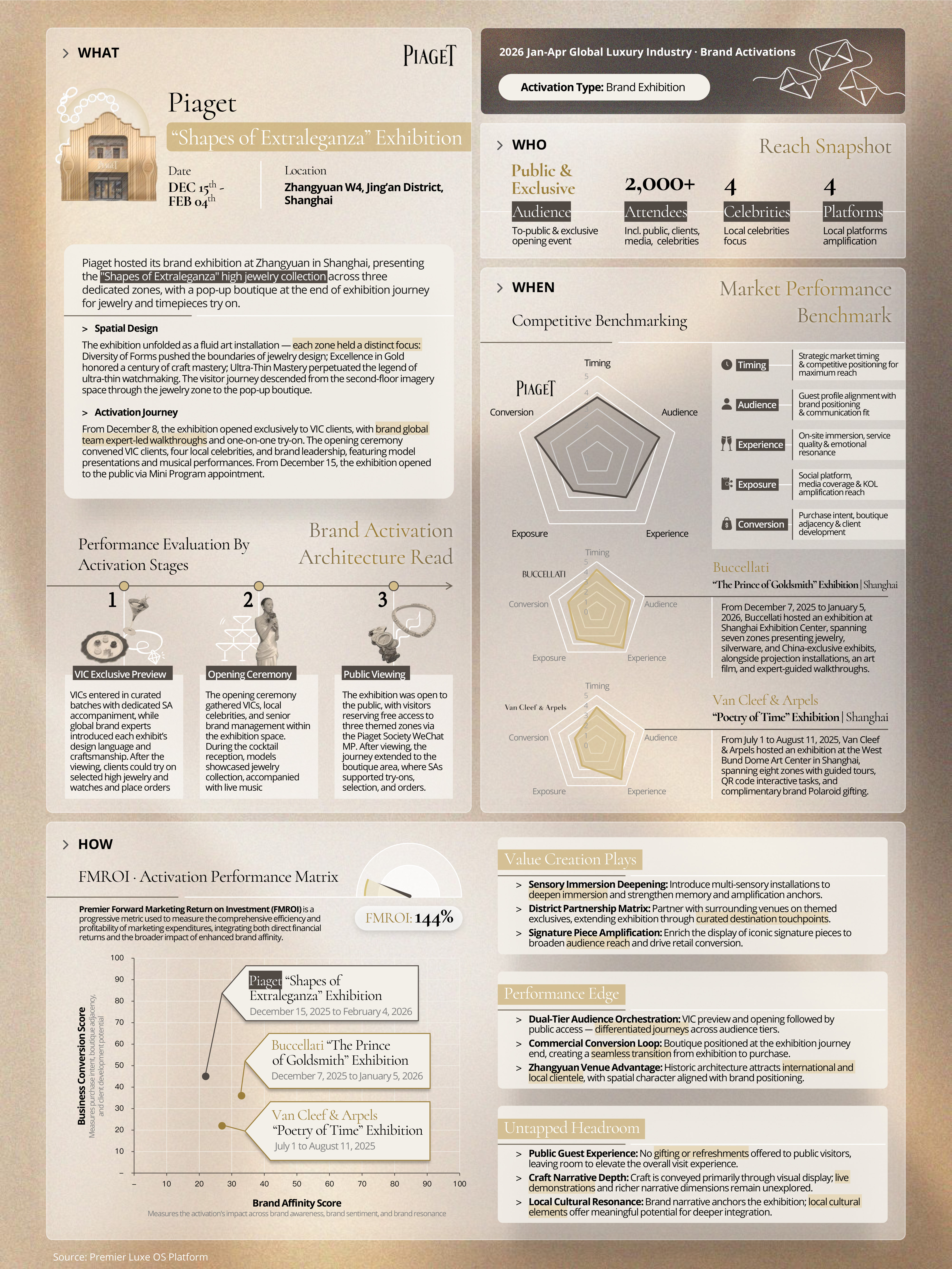
Third, the immediate perception of tangible luxury value is reshaping commercial handover. Against the backdrop of growth pressure and narrowing price elasticity, brands are being called to answer the essential question of “why it is worth it” through shorter, clearer, and more persuasive experiential pathways. Activation can no longer remain at the level of observation or admiration. It needs to translate with immediacy into product understanding, preference formation, and action readiness. Maison Margiela, Piaget, and McQueen each built a continuous journey across exhibition viewing, product appreciation, try-on, reservation, and social engagement, transforming brand activations from expressions of visibility into mechanisms for deepening product comprehension, stimulating client interest, and generating retail momentum.
The value center of luxury brand activation has therefore shifted: activation performance is no longer determined by exposure, scale, or spectacle alone. Its true value now lies in how client access, narrative construction, experiential triggers, and retail handover can be orchestrated across functions into a decision system that is identifiable, sustainable, and reusable.
In response to the growing need for systematic, intelligence-enabled activation management, Premier, powered by its proprietary Luxury OS Platform, is launching the Brand Activation Intelligence Suite, an AI agent solution purpose-built for the luxury industry. Spanning client value tiering, marketing strategy planning, experience journey orchestration, and retail handover conversion, the suite is designed to move brand activation beyond experience-led execution and retrospective review, toward a structured, data-informed, and forward-looking mode of intelligent decision-making.
A luxury brand activation
should no longer dissolve
as a fleeting moment of brilliance.
With ordered fields, grounded actions,
and assets that continue to accrue,
Luxury OS is designed to ensure
that every moment of occurrence
enters the brand’s long-term operating script —
held as a reserve of prestige,
and shaped into a foundation of value.
Related Articles
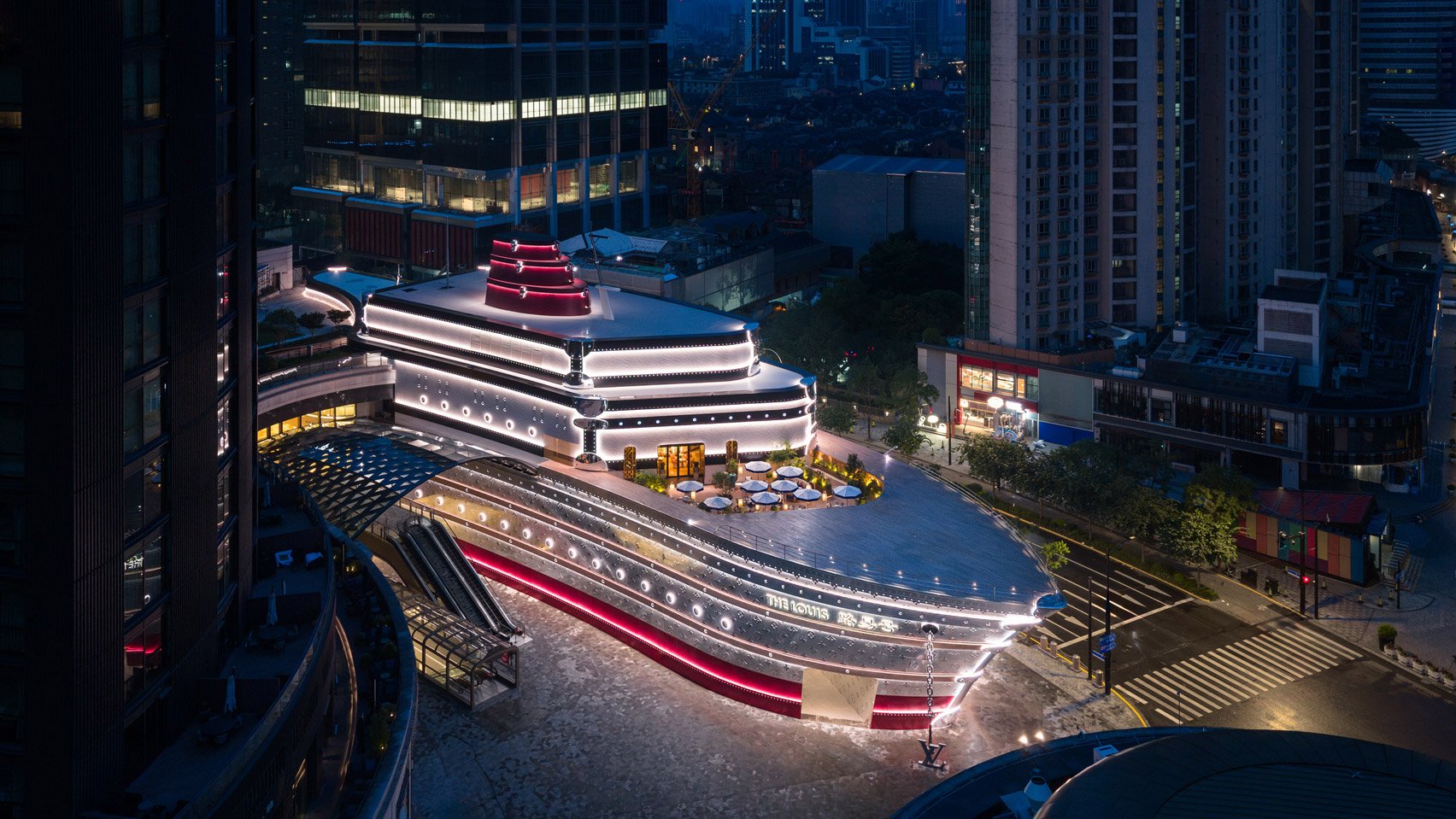
Beyond the Torrent of Attention, Towards Regenerative Capital Accretion
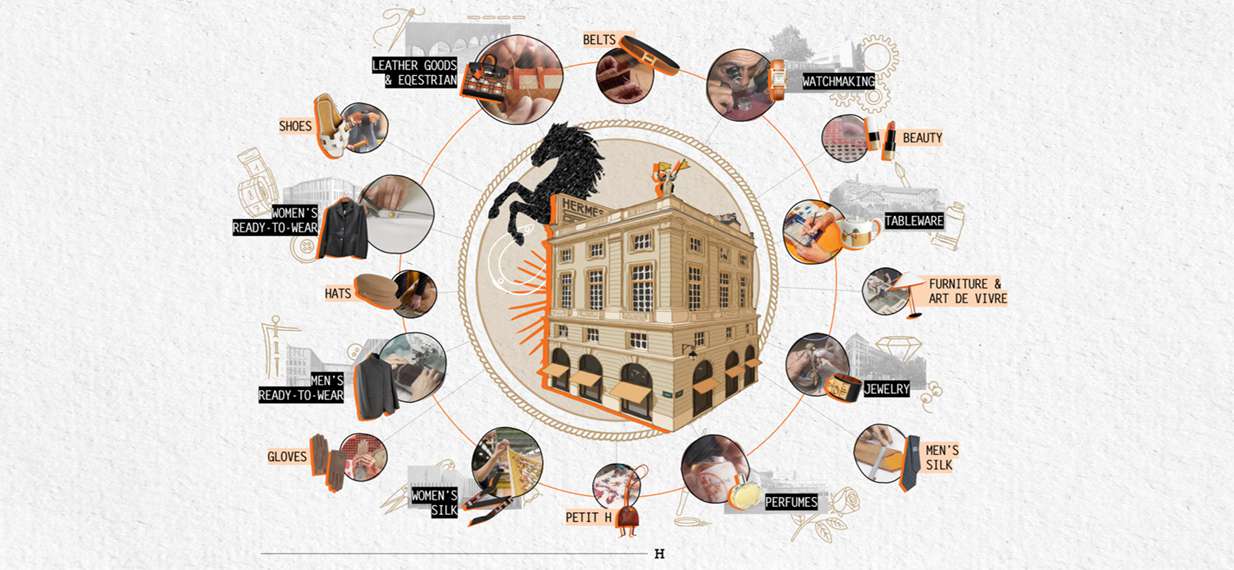
An Artisanal Ethos,
From Rein to Hand

Authentic Value Renewed:
25/26 PRMC Luxe Index
Review & Prospect

Shanghai
11/F · WSH Building
POLY GREENLAND PLAZA
198 Jingzhou Road
Shanghai PRC · 200082
London
OFFICE SUITE 29A · 3/F
23 Wharf Street
London England · SE8 3GG
Hongkong
9/F · Tower A
NEW MANDARIN PLAZA
14 Science Museum Road
Hongkong SAR · 999077