
Capabilities

Resilience in Foundation, Authentic Value Renewed:
25/26 PRMC Luxe Index Review & Prospect

Copy Url
Print
Copy Url
Print

Review the index performance across 2025, help investors understand shifting market trends, navigate short-term volatility with agility, capture key opportunities in 2026, and chart a new path for luxury growth guided by long-term value.

[2025 in a Nutshell]

Primary Index: The index faced downward pressure on its valuation anchor throughout 2025 due to a repricing of growth expectations. Extended inventory destocking, asynchronous regional recovery, and earnings volatility made it difficult to stabilize the valuation baseline. The index exhibited range-bound fluctuations with limited rebound potential.
Secondary Index: Performance diverged, driven by wealth stratification and shifting preferences. Jewelry and watches supported the Core Luxe Index through their store-of-value attributes. Private yachts and aircraft propelled the Ultra Luxe Index, buoyed by scarcity and high-ticket transactions. Spirits and liquors dragged on the Mass Luxe Index amid changing preferences and intensifying competition. The experiential consumption recovery drove steady strength in the Lifestyle Luxe Index, multiple factors such as fine retail, cruise travel, and hotel services have contributed.
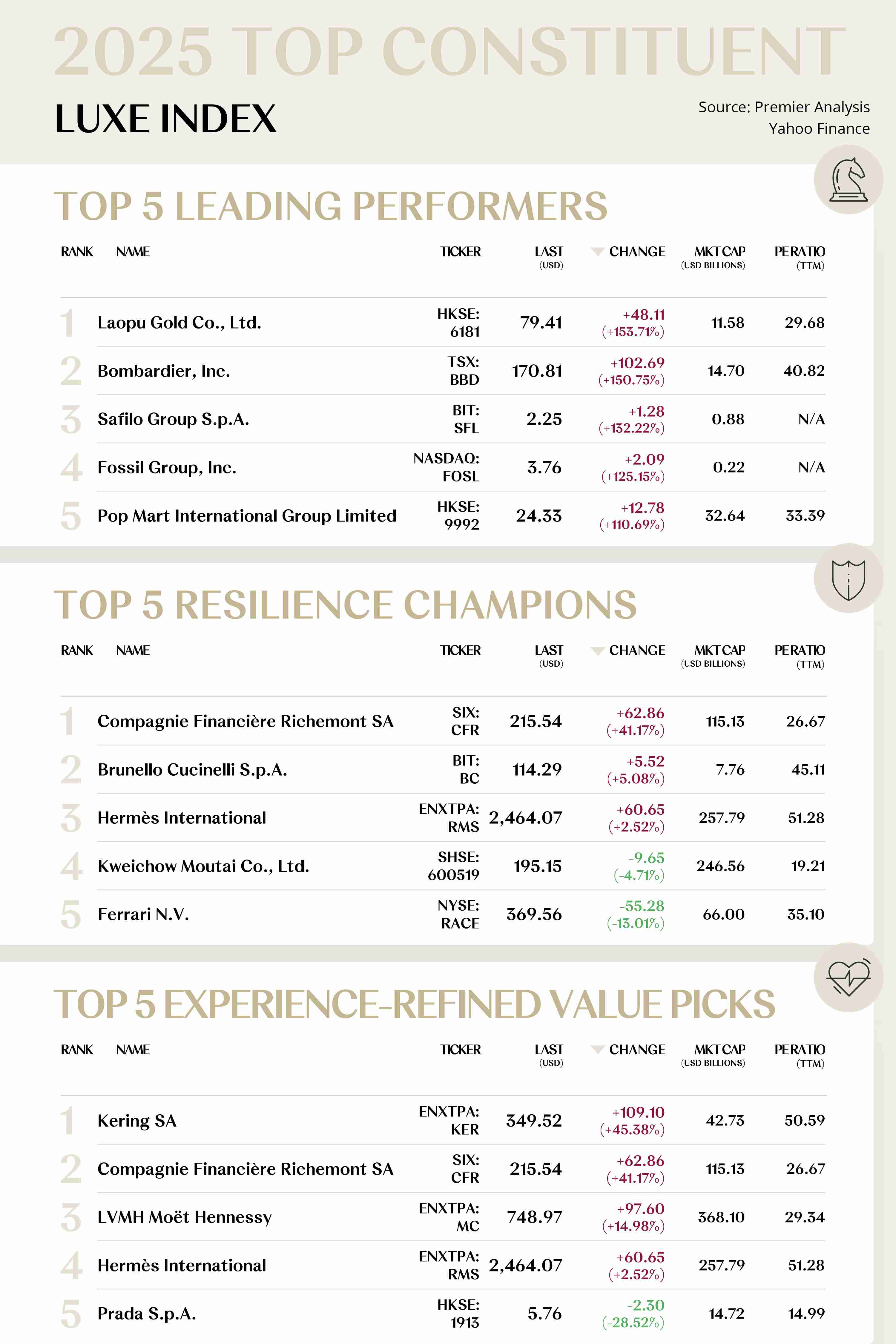
Constituent Stocks: Capital flows demonstrated a quality preference. Market leaders, with stable cash flows, strong pricing power, and controllable channel structures, became core holdings for defensive growth. Mid-tier gainers relied on event-driven catalysts or short-term operational recovery to gain flexibility during the rotation window. Tail-end constituents fell into negative feedback loops under the combined pressure of weakening demand and inventory pressure.
Macroeconomic Trends: Multi-country interest rate cuts and financial market rebounds drove wealth effects, solidifying high-net-worth consumption. Declining interest rates reduced funding costs. However, trade frictions, tariffs, and currency volatility significantly impacted cross-border tourism and duty-free channels, exacerbating the divergence in regional sales performance.


[2026 Outlook]

Primary Index: 2026 is expected to enter a phase of structural recovery, with signals of fundamental bottoming and rebound likely to strengthen. The driving logic will shift from sentiment and valuation recovery to earnings improvement and growth delivery.
Secondary Index: Divergence will become increasingly pronounced. Against high bases, the Ultra Luxe Index's growth momentum is expected to moderate, with luxury vehicle sales providing marginal support. The Core Luxe Index is poised to lead, supported by apparel and leather goods recovery plus jewelry and watches as a floor. Mass Luxe Index performance will depend on the spirits destocking and recovery pace. The Lifestyle Luxe Index's positive momentum will continue.
•Constituent Stocks: Capital flows may further demonstrate high concentration. High-resilience stocks, with financial resilience and robust earnings translating into tangible shareholder returns, will continue to command valuation premiums. Experience-focused value stocks, leveraging new consumption trends to build growth engines, will achieve long-term value refinement.
Macroeconomic Trends: Wealth effects, interest rate trajectories, and consumer confidence will dominate high-end consumption. Moderately low interest rates will support consumption and asset valuations, but uneven global economic recovery and geopolitical risks remain severe.

Looking back at 2025, the luxury sector’s performance logic shifted from “valuation expansion under a high-growth narrative” to “sentiment repair in search of certainty amid uncertainty” .The pullbacks and volatility in the index were not driven by a single shock, but rather reflected a repricing process shaped jointly by macro interest and exchange rate conditions, the pace of demand and channel inventory clearing, and brands’ pricing and supply discipline.

On the demand side, rising price sensitivity, prolonged channel destocking, and misaligned regional recovery cycles raised the bar for growth visibility and sustainability. At the same time, “wealth stratification and scenario migration” within the sector further widened divergence, prompting capital markets to move from “paying for imagination” to “pricing earnings quality and cash flow resilience.”Rising price sensitivity, extended destocking, and asynchronous regional recovery raised the market's threshold for growth visibility. Capital markets shifted from paying premiums for imagination to pricing earnings quality and cash flow resilience.

Against this backdrop, the re-anchoring of valuation for the primary index, structural divergence across secondary index, and convergence toward quality-based pricing at the stock level together defined the core evolution of the luxury sector in 2025.

More specifically, after the late-2024 correction, the market undertook a more thorough repricing of growth expectations in 2025. Although the primary index still posted full-year gains, the visibility and sustainability of growth were insufficient to support a higher valuation center. Pricing focus shifted forward from long-term narratives to current operating quality and delivery pace.

Meanwhile, the structural performance of secondary index was shaped by “wealth stratification plus scenario preference shifts”. Jewelry and watches, supported by stronger value-preservation narratives and gifting/collectible attributes, served as a stable earnings base for the Core Luxe Index. Demand from ultra-high-net-worth consumers stabilized, and segments such as private yachts and private jets, backed by scarce supply and high average order value, showed stronger momentum, lifting the Ultra Luxe Index.

By contrast, divergence within the Mass Luxe Index was more pronounced. Under shifting preferences and intensifying competition, wines and spirits became a drag, highlighting the vulnerability of discretionary consumption in a soft environment. The Experiential Luxe Index, supported by the recovery of experience-led spending and supply expansion, strengthened steadily, with boutique retail, cruise travel, and hotel services contributing from multiple fronts, underscoring the long-term trend of rising priority for experience spending.

As divergence deepened, capital market pricing became more concentrated. At the stock level, capital preference showed clear quality stratification. Leading Performers, backed by more stable cash flows, stronger pricing power, and tighter channel control, were positioned as core “defensive growth” holdings. Mid-tier Stocks relied more on event-driven catalysts or cyclical operational recovery for upside during rotation windows. Tail-end Stocks, facing weaker demand, deeper discounting, and mounting inventory pressure, fell into a negative feedback loop of “revenue decline–margin compression–investment cuts–brand erosion”.

Under this logic, leading names such as Laopu Gold, Bombardier, Safilo, Fossil Group, and Pop Mart stood out and became market favorites.

From a macro perspective, rate cuts in multiple countries and financial market rebounds generated a tangible wealth effect that underpinned high-end consumption, while marginal rate declines offered temporary valuation relief. At the same time, exchange rate volatility, trade frictions, and tariff uncertainty amplified regional sales divergence, making cross-border tourism and duty-free channels more sensitive to external variables.

Overall, the macro environment did not provide a clear one-way driver. Instead, multiple variables jointly reshaped the regional demand gradient, pushing the luxury sector into a regime characterized by “widening divergence and normalized volatility”.

Looking ahead to 2026, the main index narrative is likely to shift from “sentiment repair” to “fundamental repricing”. As policy and liquidity support gradually fade at the margin, external frictions persist, and operational divergence deepens, the market’s tolerance for distant narratives will decline further. Pricing anchors will concentrate more on verifiable earnings quality, cash flow resilience, and delivery pace.

Index upside is expected to come primarily from valuation stability and selective re-rating driven by earnings certainty, rather than broad-based multiple expansion. Companies capable of consistently delivering profits and free cash flow are likely to form the core of index resilience.

Under the constraints of a high base and softer expectations, secondary index will show clearer divergence. For Core Luxe Index, a recovery in ready-to-wear and leather goods, supported by disciplined channel control and product cadence, together with the steady contribution of jewelry and watches, could restore sector leadership. The Ultra Luxe Index may see marginally slower momentum, but its attributes of scarce supply and high certainty should continue to support allocation value.
 

Term Name

Technology Introduction

Energy is life. It powers industries, empowers communities, and builds societies. The world needs energy—affordable, reliable, and sustainable energy. But meeting the world’s energy requirements with net-zero climate impact is one of today’s most complex challenges.

Energy companies need to leverage the latest technologies, re-engineer processes, and rethink business models to drive change. Premier works with clients to build sustainable, competitive energy solutions to achieve a net-zero energy world for all.

Business Application

  • Customization of Medical Devices, Prosthetics and Prostheses: Customized manufacturing can be carried out, designed and manufactured according to the individual needs of patients, and more suitable solutions can be provided
  • Manufacture Lightweight Components: For rapid prototyping, customized production and small batch production, it can reduce production cycle and cost

Related Giant

Related Technology Trend

Related Technology

Review the index performance across 2025, help investors understand shifting market trends, navigate short-term volatility with agility, capture key opportunities in 2026, and chart a new path for luxury growth guided by long-term value.

[2025 in a Nutshell]

Primary Index: The index faced downward pressure on its valuation anchor throughout 2025 due to a repricing of growth expectations. Extended inventory destocking, asynchronous regional recovery, and earnings volatility made it difficult to stabilize the valuation baseline. The index exhibited range-bound fluctuations with limited rebound potential.
Secondary Index: Performance diverged, driven by wealth stratification and shifting preferences. Jewelry and watches supported the Core Luxe Index through their store-of-value attributes. Private yachts and aircraft propelled the Ultra Luxe Index, buoyed by scarcity and high-ticket transactions. Spirits and liquors dragged on the Mass Luxe Index amid changing preferences and intensifying competition. The experiential consumption recovery drove steady strength in the Lifestyle Luxe Index, multiple factors such as fine retail, cruise travel, and hotel services have contributed.
Constituent Stocks: Capital flows demonstrated a quality preference. Market leaders, with stable cash flows, strong pricing power, and controllable channel structures, became core holdings for defensive growth. Mid-tier gainers relied on event-driven catalysts or short-term operational recovery to gain flexibility during the rotation window. Tail-end constituents fell into negative feedback loops under the combined pressure of weakening demand and inventory pressure.
Macroeconomic Trends: Multi-country interest rate cuts and financial market rebounds drove wealth effects, solidifying high-net-worth consumption. Declining interest rates reduced funding costs. However, trade frictions, tariffs, and currency volatility significantly impacted cross-border tourism and duty-free channels, exacerbating the divergence in regional sales performance.


[2026 Outlook]

Primary Index: 2026 is expected to enter a phase of structural recovery, with signals of fundamental bottoming and rebound likely to strengthen. The driving logic will shift from sentiment and valuation recovery to earnings improvement and growth delivery.
Secondary Index: Divergence will become increasingly pronounced. Against high bases, the Ultra Luxe Index's growth momentum is expected to moderate, with luxury vehicle sales providing marginal support. The Core Luxe Index is poised to lead, supported by apparel and leather goods recovery plus jewelry and watches as a floor. Mass Luxe Index performance will depend on the spirits destocking and recovery pace. The Lifestyle Luxe Index's positive momentum will continue.
•Constituent Stocks: Capital flows may further demonstrate high concentration. High-resilience stocks, with financial resilience and robust earnings translating into tangible shareholder returns, will continue to command valuation premiums. Experience-focused value stocks, leveraging new consumption trends to build growth engines, will achieve long-term value refinement.
Macroeconomic Trends: Wealth effects, interest rate trajectories, and consumer confidence will dominate high-end consumption. Moderately low interest rates will support consumption and asset valuations, but uneven global economic recovery and geopolitical risks remain severe.

Looking back at 2025, the luxury sector’s performance logic shifted from “valuation expansion under a high-growth narrative” to “sentiment repair in search of certainty amid uncertainty” .The pullbacks and volatility in the index were not driven by a single shock, but rather reflected a repricing process shaped jointly by macro interest and exchange rate conditions, the pace of demand and channel inventory clearing, and brands’ pricing and supply discipline.

On the demand side, rising price sensitivity, prolonged channel destocking, and misaligned regional recovery cycles raised the bar for growth visibility and sustainability. At the same time, “wealth stratification and scenario migration” within the sector further widened divergence, prompting capital markets to move from “paying for imagination” to “pricing earnings quality and cash flow resilience.”Rising price sensitivity, extended destocking, and asynchronous regional recovery raised the market's threshold for growth visibility. Capital markets shifted from paying premiums for imagination to pricing earnings quality and cash flow resilience.

Against this backdrop, the re-anchoring of valuation for the primary index, structural divergence across secondary index, and convergence toward quality-based pricing at the stock level together defined the core evolution of the luxury sector in 2025.

More specifically, after the late-2024 correction, the market undertook a more thorough repricing of growth expectations in 2025. Although the primary index still posted full-year gains, the visibility and sustainability of growth were insufficient to support a higher valuation center. Pricing focus shifted forward from long-term narratives to current operating quality and delivery pace.

Meanwhile, the structural performance of secondary index was shaped by “wealth stratification plus scenario preference shifts”. Jewelry and watches, supported by stronger value-preservation narratives and gifting/collectible attributes, served as a stable earnings base for the Core Luxe Index. Demand from ultra-high-net-worth consumers stabilized, and segments such as private yachts and private jets, backed by scarce supply and high average order value, showed stronger momentum, lifting the Ultra Luxe Index.

By contrast, divergence within the Mass Luxe Index was more pronounced. Under shifting preferences and intensifying competition, wines and spirits became a drag, highlighting the vulnerability of discretionary consumption in a soft environment. The Experiential Luxe Index, supported by the recovery of experience-led spending and supply expansion, strengthened steadily, with boutique retail, cruise travel, and hotel services contributing from multiple fronts, underscoring the long-term trend of rising priority for experience spending.

As divergence deepened, capital market pricing became more concentrated. At the stock level, capital preference showed clear quality stratification. Leading Performers, backed by more stable cash flows, stronger pricing power, and tighter channel control, were positioned as core “defensive growth” holdings. Mid-tier Stocks relied more on event-driven catalysts or cyclical operational recovery for upside during rotation windows. Tail-end Stocks, facing weaker demand, deeper discounting, and mounting inventory pressure, fell into a negative feedback loop of “revenue decline–margin compression–investment cuts–brand erosion”.

Under this logic, leading names such as Laopu Gold, Bombardier, Safilo, Fossil Group, and Pop Mart stood out and became market favorites.

From a macro perspective, rate cuts in multiple countries and financial market rebounds generated a tangible wealth effect that underpinned high-end consumption, while marginal rate declines offered temporary valuation relief. At the same time, exchange rate volatility, trade frictions, and tariff uncertainty amplified regional sales divergence, making cross-border tourism and duty-free channels more sensitive to external variables.

Overall, the macro environment did not provide a clear one-way driver. Instead, multiple variables jointly reshaped the regional demand gradient, pushing the luxury sector into a regime characterized by “widening divergence and normalized volatility”.

Looking ahead to 2026, the main index narrative is likely to shift from “sentiment repair” to “fundamental repricing”. As policy and liquidity support gradually fade at the margin, external frictions persist, and operational divergence deepens, the market’s tolerance for distant narratives will decline further. Pricing anchors will concentrate more on verifiable earnings quality, cash flow resilience, and delivery pace.

Index upside is expected to come primarily from valuation stability and selective re-rating driven by earnings certainty, rather than broad-based multiple expansion. Companies capable of consistently delivering profits and free cash flow are likely to form the core of index resilience.

Under the constraints of a high base and softer expectations, secondary index will show clearer divergence. For Core Luxe Index, a recovery in ready-to-wear and leather goods, supported by disciplined channel control and product cadence, together with the steady contribution of jewelry and watches, could restore sector leadership. The Ultra Luxe Index may see marginally slower momentum, but its attributes of scarce supply and high certainty should continue to support allocation value.