

Reconstructing the Cycle, Unlocking a New Value-Chain Equilibrium:
25/26 PRMC Forward Mobility Index Review & Prospect
Reconstructing the Cycle, Unlocking a New Value-Chain Equilibrium:
25/26 PRMC Forward Mobility Index Review & Prospect


Reconstructing the Cycle, Unlocking a New Value-Chain Equilibrium:
25/26 PRMC Forward Mobility Index Review & Prospect
Sep 16, 2026
To help investors and industry professionals stay balanced amid disruption and act with foresight amid long-term shifts, uphold a long-term investment philosophy, reflect on the key trends of 2025, and capture structural opportunities in the automotive sector of future mobility in 2026.
[2025 in a Nutshell]
• Primary Index: Under the combined influence of the "policy cycle + technology cycle" the index maintained a recovery trend throughout the year. Domestic and foreign policies have supported improved demand expectations, while technological iteration has determined industry discourse power and valuation centers.
• Secondary Index: The secondary index has exhibited rebalancing along the supply chain. The upstream sector is more strongly influenced by resource prices and supply-demand cycles. The midstream manufacturing sector faces pressure from price competition; however, leading companies are stabilizing profitability through efficiency and scale. The downstream channels and services demonstrate long-term resilience driven by replacement cycles, finance, and after-sales ecosystems.
• Constituent Stocks: Market preference for "delivery capability" has significantly increased. Delivery volume and market share are no longer the only metrics; profitability, expense ratios, cash flow, overseas channels, and supply chain control profoundly influence corporate valuations.
• Macroeconomic Trends: A "regional divergence" is observed, with discrepancies in manufacturing cycles and consumption resilience among different economies, resulting in asynchronous recovery in automobile demand. The evolving trade environment and industrial policies are reshaping global supply chains, with tariffs, origin rules, subsidies, and entry barriers structurally overlapping.
• Industry Operations: The focus has shifted from "incremental expansion" to "stock game." Cost reduction through platformization, supply chain negotiation power, and channel efficiency have become critical dividing lines, with demand increasingly driven by the penetration of new energy sources and structural upgrades.
[2026 Outlook]
• Primary Index: Entering the "growth repricing" phase, the marginal effects of policy, overseas trade, and technological regulation collectively determine risk premiums. Opportunities for the index will increasingly arise from the certainty of profit realization rather than mere valuation expansion.
• Secondary Index: The rebalancing logic continues, with future directions becoming increasingly clear. The upstream sector focuses more on "cost curves and capacity clearance," the midstream sector emphasizes "cost reduction through platformization and product structure upgrades," while the downstream sector pays greater attention to "operational efficiency, data-driven engagement, and service subscription penetration."
• Constituent Stocks: High-quality stocks rely on established systems to hedge against cyclical volatility, consolidating their dominant positions. Growth stocks accelerate the commercialization of technology through new models, achieving elevated performance levels. Mid-tier stocks face triple pressures from financing, competition, and policy, with existential questions becoming prominent.
• Macroeconomic Trends: Global demand manifests as "structural highlights under low growth." The maneuvering space of emerging markets, the pace of electrification policies in Europe, consumption and interest rate constraints in North America, and supply chain advantages in Asia will jointly contribute to rebalancing among regions.
• Industry Operations: The domestic price war continues in a "silent" form, with the low-end market remaining under pressure, while the mid-to-high end competes for a new round of pricing power through product structure adjustments. Exports and overseas expansion will become essential strategies to hedge against fluctuations in domestic demand cycles.
Looking back at 2025, the PRMC Forward Mobility Car Index rose further on a stable foundation from the previous year. This underlying logic is not merely a recovery of risk appetite but represents an adjustment process driven by the policy cycle and technology cycle:
Firstly, Marginal support from the policy cycle. Major global economies continuously calibrate expectations between declining inflation and interest rate paths, while domestic signals for steady growth and industrial upgrading are increasingly reinforced, improving industry prosperity expectations and risk premiums in tandem.
Second, Ongoing elevation of the technology cycle. Acceleration in electrification, intelligent technology, power semiconductors, and software capabilities has shifted the competitive focus from “sales expansion” to “system capabilities and long-term winning rates.” The overlay of these two forces has allowed the index to continue its recovery amid fluctuations, anchoring the valuation center more firmly on the mainline of “technological leadership + profit realization.”
Consequently, the secondary index exhibits value rebalancing along the industrial chain. The upstream sector is driven by commodity prices and supply-demand cycles; the midstream sector tests efficiency amid competitive intensity; and the downstream sector consolidates compounding benefits through service-oriented and ecosystem approaches.
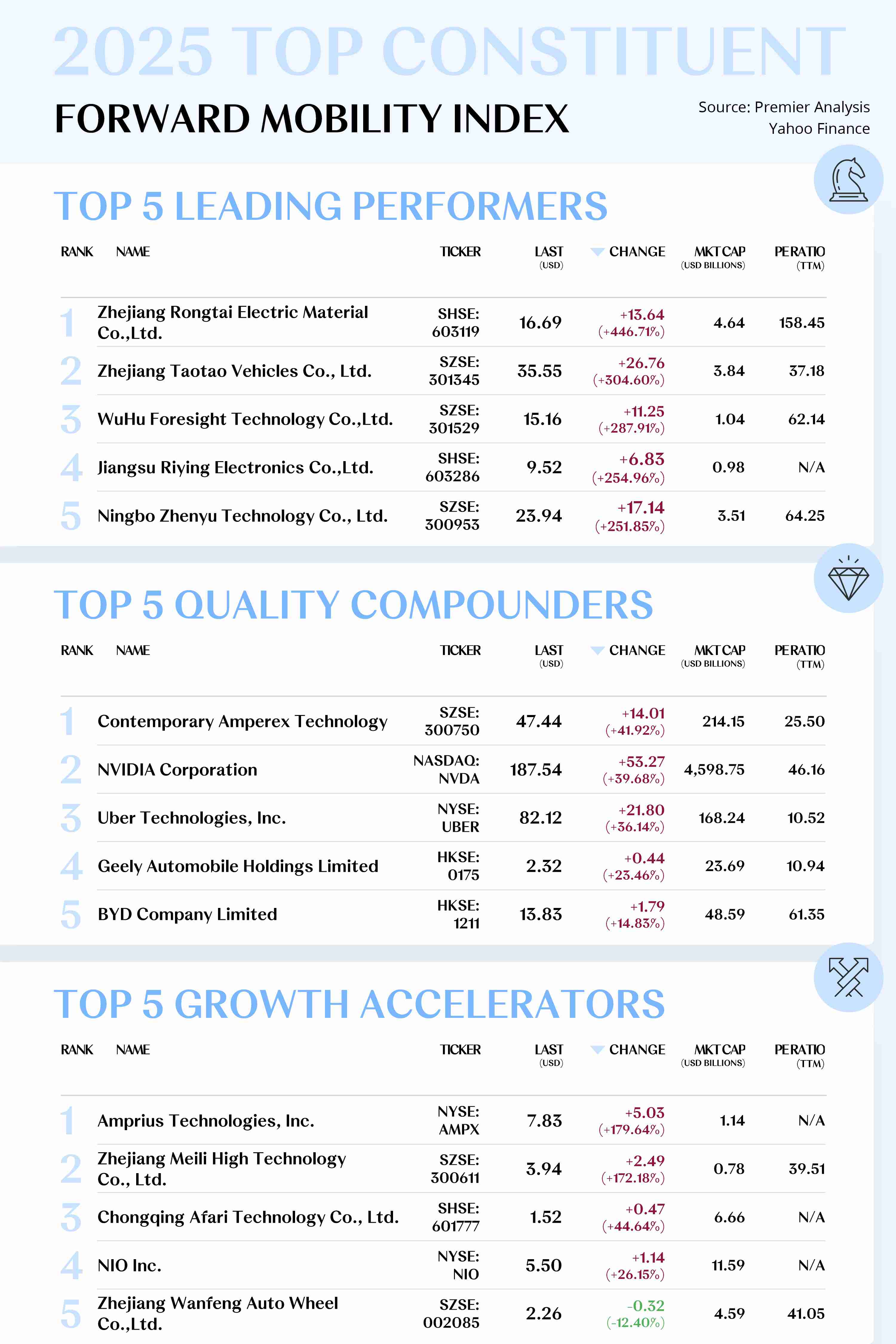
As differentiation gradually becomes evident, capital market pricing preferences contract correspondingly. The valuation logic for individual stocks has shifted from "growth narrative" to "delivery capability." Investors are increasingly concerned with whether companies can convert scale advantages into profit quality and transform growth into sustainable cash flows. At the same time, factors such as overseas channel development, localization capabilities, control over key components, and supply chain resilience are beginning to directly affect companies’ operational elasticity and stability amid changes in the external environment. Under this logic, leading performers such as Zhejiang Rongtai, Taotao Automotive, Wuhu Fuzzai, Riying Electronics, and Zhenyu Technology have emerged from the market as capital favorites.
From a macro perspective, the screening logic at the corporate level is further amplified by external variables. The manufacturing cycle and consumption resilience are misaligned between different economies, making it difficult for the recovery pace of automobile demand to be synchronized. Meanwhile, the shift in trade, environmental, and industrial policies has reshaped the boundaries of global supply chains, with tariffs, origin rules, subsidy arrangements, and entry barriers creating systematic constraints that directly impact companies' cost curves, product mix, and overseas market strategies.
At the industry level, the transition in 2025 marks the industry's shift from "incremental expansion" to the pre-phase of "stock competition": the price war continues, with demand increments increasingly derived from rising penetration of new energy and structural upgrades, while profit increments predominantly stem from product structure optimization, overseas market expansion, and the realization of full lifecycle operations (services, finance, subscriptions, and data monetization).
The overarching theme for the index in 2026 is expected to shift from “confidence recovery” to “repricing”. As marginal policy support converges, overseas trade friction persists, and technological/compliance regulations tighten, industry risk premiums will undergo systematic reassessment. The capital market's tolerance for long-term narratives will decrease, with pricing anchors becoming more focused on verifiable profitability quality, cash flow resilience, and delivery cadence.
In other words, the primary source of the index's upward movement will stem from the stability of valuation centers and structural uplift driven by “profit certainty,” rather than the broad-based valuation expansion driven by sentiment. Companies capable of consistently delivering profits and free cash flow in uncertain environments are more likely to become core contributors to the index's resilience.
Within this framework, the rebalancing of the secondary index will evolve from a phase-driven phenomenon into a normalized pattern. The core observation point for the upstream sector will be “cost curves + capacity clearance”. As supply and demand shift from a tight balance to recalibration, price and profit elasticity will revert to fundamentals. The midstream manufacturing sector remains the battleground for price competition, but the key to victory will shift from “scale expansion” to a combination of “platform-based cost reduction + product structure upgrades”. Only those leading companies that can convert scale advantages into efficiency and solidify that efficiency into profits will stabilize their gross profit floor and secure relative pricing power. The focus for downstream channels and services will center on three main lines: “enhancing operational efficiency, improving data-driven engagement capabilities, and increasing subscription penetration”. Participants who can deepen user lifecycle management and transition services and financing from one-off promotions to sustainable recurring cash flows will achieve higher elastic returns as demand rebounds.
Consequently, the competitive landscape among individual stocks will also be restructured. Quality compounders such as CATL, NVIDIA, Uber Technologies, Geely Auto, and BYD, leveraging mature supply chain systems, global layouts, and ample financial strength, can effectively hedge against cyclical risks and stabilize operational rhythms during market volatility, even capturing market share amid an overall industry contraction, further consolidating their leading positions.
Growth Accelerators such as Amprius, Mele Technology, Qianli Technology, NIO, and Wan Feng Auto Wheel will encounter more opportunities arising from the commercialization of new models and technologies. The key lies not in having more cutting-edge concepts, but in achieving faster conversions and clearer unit economic benefits. Only those enterprises capable of quickly translating technological advantages into scalable revenues and improved profit structures will possess the potential for significant performance leaps.
However, mid-tier companies face increasingly severe challenges. A tightening financing environment, intensified price competition, and stricter policies have turned cash flow and compliance costs into stringent survival constraints, making market scrutiny more direct and harsh.
From a macro perspective, emerging markets still offer room for increased mobility rates and expansion of vehicle ownership, providing sustainable incremental support for exports and international expansion. The electrification process in Europe is more driven by institutional and regulatory factors, yet the simultaneous rise in industry protectionism and compliance thresholds compels companies to adapt through more flexible power combination strategies and deeper localization efforts. North American demand remains constrained by interest rates and consumer spending, with recovery paths characterized by "slow increases and heightened differentiation“. Asia's supply chain advantages continue to be a crucial pillar for the global automotive industry; however, in the context of adjustments to trade rules and strengthened origin requirements, “supply chain advantages” are shifting from mere cost advantages to a comprehensive competitiveness anchored in industrial synergy, compliance capabilities, and global operational frameworks.
The competitive environment in 2026 will resemble a “low intensity, long cycle” battle of attrition: price competition is expected to continue in a more subtle and persistent manner, with sustained pressure on the lower-end market and profit margins being repeatedly compressed through multiple rounds of contention. The mid-to-high end market will compete for a new round of pricing power by reconstructing product structures and value systems—systemic values such as intelligent experiences, three-electric efficiency, comfort, and safety will better define premium boundaries and brand tiers than single-point parameters.
Meanwhile, export and overseas expansion will transition from being “growth options” to key levers for “cyclical hedging and structural upgrades.” Their significance lies not only in contributing to sales increases but also in enhancing capacity utilization, achieving cost dilution, and strengthening brand momentum through external expansion, while validating product and organizational capabilities in the global market.
DOWNLOADS
Lite Report (101 pages)
Related Articles

Five Pivotal Roles Orchestrating
Glocal Organization Integration

Escaping the Value Trap
in the Intelligent Driving Era

Value Reimagined:
Automotive Industry Outlook 2026

Shanghai
11/F · WSH Building
POLY GREENLAND PLAZA
198 Jingzhou Road
Shanghai PRC · 200082
London
OFFICE SUITE 29A · 3/F
23 Wharf Street
London England · SE8 3GG
Hongkong
9/F · Tower A
NEW MANDARIN PLAZA
14 Science Museum Road
Hongkong SAR · 999077